Some treatments ask you to plan around them. These two ask almost nothing. DiamondGlow and dermaplaning are the two no-downtime facials people in Dallas reach for when they want skin that looks lit-from-within now — before an event, before photos, or simply on the way through an ordinary week. Here is what each one actually does, who they suit, and why so many people book them together.
Part of our complete guide to skin rejuvenation.
The short version, for anyone who wants the answer before the detail: DiamondGlow is a diamond-tip resurfacing treatment that exfoliates and infuses SkinMedica serums in a single pass for an immediate glow, and dermaplaning is a precise manual exfoliation with a sterile blade that lifts away dead skin and fine peach fuzz for a smoother, brighter surface. Neither requires recovery time. Both are best maintained on a monthly rhythm. Below, we take them one at a time, then show how they fit together and where a HydraFacial-style treatment sits alongside them.
DiamondGlow — resurface and infuse, in one pass
DiamondGlow is a medical-grade resurfacing facial built around a single clever idea: do three jobs at once. The device uses a diamond-tip wand that gently abrades the surface to remove dead, dulling skin. At the same moment, it uses controlled suction to lift away debris and clear pores, and it infuses a targeted SkinMedica serum directly into the freshly resurfaced skin. Exfoliation, extraction, and serum delivery happen together, which is why the finish reads as more polished and more even than surface cleansing alone can typically achieve.
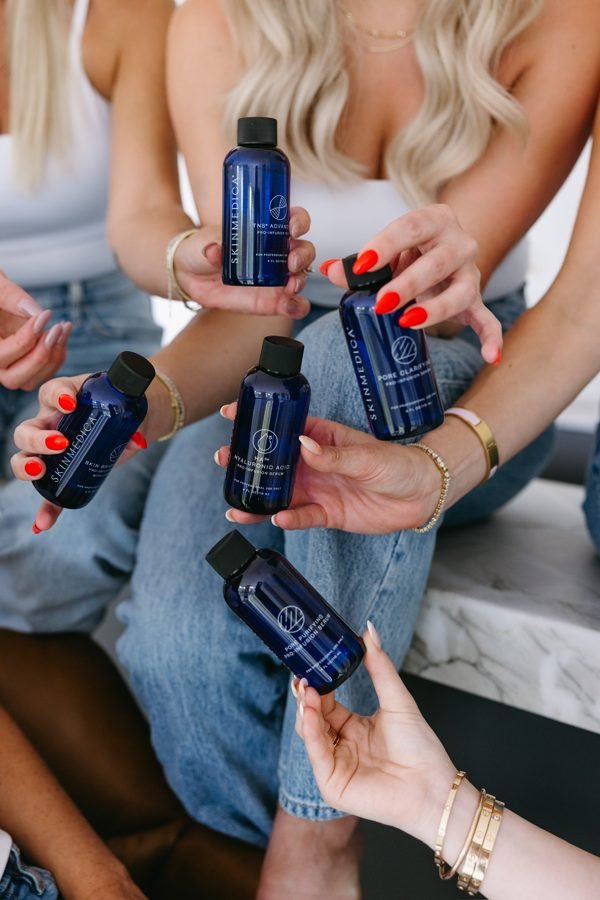
The serum step is what makes DiamondGlow feel bespoke rather than generic. SkinMedica offers professional formulations aimed at different concerns — brightening and tone, hydration and plumping, or a clarifying, pore-refining focus — and your provider selects the one that matches what your skin needs that day. Because the skin has just been resurfaced, it tends to be more receptive to those ingredients than it would be at home over an unexfoliated surface. The experience itself is comfortable and quick, with a fresh, slightly cooled feeling rather than anything you would describe as aggressive.
It helps to picture why combining the three steps matters. On unexfoliated skin, a serum applied at home meets a layer of dead cells first, and much of what makes the formula effective never reaches the living skin beneath. DiamondGlow inverts that sequence: it clears the dead layer and lifts debris in the same motion that delivers the serum, so the active ingredients land on a surface that can actually take them up. That is the difference between a product working on your skin and a product working over it, and it is the reason a single in-studio session can read as more luminous than weeks of careful home care over a congested surface.
What it is good for: an immediate, even glow with no recovery. DiamondGlow can help skin look brighter, feel smoother, and sit more receptively under makeup, which is why it has earned a reputation as a red-carpet or event-prep treatment — the sort of thing you book a day or two before you want to look your most refined. It is not a resurfacing laser and does not set out to remodel deeper texture or scarring; it is a glow-and-maintenance treatment, and judged on that goal it is genuinely satisfying. Results vary, and a single session gives an instant lift while a monthly cadence is where the compounding benefit lives.
A few words on who tends to love it. DiamondGlow suits skin that looks dull, feels rough, or has shallow congestion and visible pores, as well as anyone whose makeup never quite sits the way they would like. It is gentle enough that most skin types tolerate it well, and the serum can be chosen to lean hydrating for drier skin or clarifying for oilier, more congested skin. As with everything in the studio, candidacy is individual: very reactive skin, active breakouts, or certain recent treatments may mean we adjust the approach or recommend a different starting point, which is part of what a consultation is for.
Dermaplaning — the blade that brightens
Dermaplaning is one of the most low-key, satisfying treatments in skincare, and it is far simpler than it sounds. A provider holds a sterile surgical blade at a precise angle and draws it gently across the skin in short strokes. Two things come away: the outermost layer of dead, built-up skin cells, and the fine vellus hair most people call peach fuzz. The skin underneath is immediately smoother to the touch, brighter to the eye, and noticeably more even.
The benefits are practical as much as they are aesthetic. Makeup applied over freshly dermaplaned skin sits flat and looks airbrushed rather than catching on fuzz or flaking over dry patches — one reason it is a favorite before weddings, photo shoots, and on-camera days. It also improves product penetration: with the dead-skin barrier lifted, the serums and moisturizers you apply afterward, including a DiamondGlow infusion or your at-home regimen, reach living skin more easily. And it is genuinely no-downtime. You walk out with a glow and can wear makeup the same day, though we keep the skin gently protected and recommend diligent sunscreen, since a freshly exfoliated surface is more exposed to the Texas sun.
The most common worry — that removing peach fuzz makes hair grow back thicker or darker — is a myth, and an old one. Dermaplaning works only at the surface and does not touch the hair follicle, so vellus hair returns exactly as it was: the same fine texture, the same light color. Regrowth can feel faintly blunt at first because the tip was cut straight across rather than tapering naturally, but the hair itself is unchanged. There is no thickening, no darkening, and no acceleration. The myth persists because blunt-tipped regrowth can momentarily look or feel more present than a tapered, never-cut hair, but feeling is not the same as biology, and the follicle that determines a hair's thickness and color is untouched by a surface treatment.
A reasonable second question is whether dermaplaning suits every skin. For most people it does, and it is one of the gentler exfoliation options available because it is purely mechanical and surface-level, with no acids, heat, or downtime. The main consideration is active, inflamed acne: drawing a blade across raised, broken-out skin is not comfortable or advisable, so we would treat the breakout first and dermaplane once the skin has settled. Very reactive or rosacea-prone skin is assessed case by case. None of this is a reason for most people to hesitate — it is simply why we look at your skin before we pick up a blade, rather than treating dermaplaning as one-size-fits-all.
DiamondGlow vs HydraFacial vs dermaplane — how they compare
Because all three of these treatments promise a no-downtime glow, it helps to see them side by side. The honest summary is that DiamondGlow and a HydraFacial-style treatment are close cousins — both exfoliate, extract, and infuse serums in one session, and the difference is mostly in the method — while dermaplaning is a distinct technique that does one thing exceptionally well and pairs beautifully with either.
| DiamondGlow | Dermaplane | HydraFacial-style | |
|---|---|---|---|
| What it does | Resurfaces, extracts, and infuses serum in one pass for an even, polished glow. | Lifts dead skin and removes peach fuzz for a smoother, brighter, makeup-ready surface. | Cleanses, exfoliates, extracts, and infuses serum for a hydrated, refreshed glow. |
| Exfoliation method | Physical diamond-tip wand. | Manual sterile surgical blade. | Water and vortex-based tip. |
| Serum infusion | Yes — targeted SkinMedica serums. | No — but serums applied afterward penetrate better. | Yes — device-specific serum boosters. |
| Best for | An instant, even, event-ready glow and routine resurfacing. | Smooth, fuzz-free skin and flawless makeup application. | Hydration-forward refresh and congested or dull skin. |
| Downtime | None typically; possible brief mild redness. | None typically; possible brief mild redness. | None typically; possible brief mild redness. |
The takeaway is not that one wins. DiamondGlow and a HydraFacial-style treatment occupy nearly the same role, and the right choice between them comes down to your skin and which method your provider feels suits it best. Dermaplaning answers a different question entirely — surface smoothness and peach fuzz — which is exactly why it is so often added to either rather than chosen instead of them.
One practical way to think about it: if your priority is hydration and a refreshed, plumped feeling, a HydraFacial-style treatment leans that way; if your priority is a polished, even resurfacing with a serum matched to a specific concern, DiamondGlow is the natural pick; and if your priority is a flawless makeup surface and that distinctive just-dermaplaned smoothness, the blade is the answer. Most people do not have to choose in the abstract, because the right combination becomes obvious once a provider has seen the skin in front of them. That is the real value of starting with a consultation rather than a category — the plan is built around your face, not around a treatment name.
Why they pair so well
Dermaplaning and DiamondGlow are a natural sequence. Done first, dermaplaning clears away the dead-skin layer and the fine vellus hair, leaving a clean, even canvas. The DiamondGlow step then resurfaces and infuses its serum into skin that is already primed to receive it, so the infusion reaches further and the finished glow looks more uniform. It is the difference between watering a garden through a layer of leaf litter and watering it once the bed is cleared.
Together they make a thorough, still-no-downtime glow treatment that suits the moments when you want to look your most refined — the week of a wedding, the morning of a shoot, the lead-up to an event — as well as the unremarkable weeks in between, when consistency is what keeps skin looking its best. Pairing is a preference, not a requirement; many people are perfectly happy alternating the two, or keeping one as their standing monthly ritual. Your provider can map the right combination at a consultation.
What a visit actually feels like
Because these treatments are gentle and quick, the appointment itself is unhurried and easy. A session typically begins with a brief look at your skin and a short conversation about your goal that day — an event coming up, a particular concern, or simply routine maintenance — which guides the serum selection for DiamondGlow and confirms that dermaplaning is right for your skin in that moment. The skin is then cleansed to clear surface makeup and oil so the treatment works on a clean canvas.
If you are dermaplaning, the provider works in small, deliberate sections, holding the blade at a shallow angle and moving in short strokes. It is comfortable for most people and can feel oddly soothing — many describe it as a soft brushing rather than anything sharp, though sensitivity varies from person to person. If you are having DiamondGlow, the diamond-tip wand passes over the skin in smooth, overlapping paths, with a gentle suction sensation and a cool, hydrated feeling as the serum goes in. When the two are paired, dermaplaning comes first to clear the canvas, then the DiamondGlow pass follows. Start to finish, a single treatment is short enough to fit into a lunch break, and a pairing only modestly longer. You leave with skin that already looks brighter, with no marks, peeling, or visible signs that you have had anything done beyond looking notably fresher.
Aftercare and the Dallas sun
The aftercare for both treatments is refreshingly simple, with one rule that matters more here than almost anywhere: sun protection. Freshly exfoliated skin has had its outermost protective layer thinned, which is exactly what makes it look so smooth and receptive — and also what leaves it a little more exposed to ultraviolet light. In a city like Dallas, where the sun is strong for much of the year, diligent broad-spectrum sunscreen in the days afterward is not a suggestion but the single most useful thing you can do to protect and extend your result. We will send you out with clear guidance.
Beyond sunscreen, keep things gentle for a day or two. It is best to pause strong actives such as retinoids and acid exfoliants immediately afterward, to skip vigorous heat like saunas or hot yoga the same day, and to let the skin rest rather than layering on a heavy routine. Makeup is generally fine the same day, which is part of the appeal — though many people find the glow looks so good bare that they happily skip it. Mild, temporary redness is the most you should expect, and it usually fades within hours. If you ever have a question after a visit, we would rather you ask than wonder, and individual responses do vary.
How often, and where membership fits
For most people, a monthly cadence is the sweet spot. That interval roughly tracks the skin's natural cell-turnover cycle, so a monthly resurfacing keeps the surface consistently smooth and luminous rather than letting dullness build and resetting it occasionally. It is gentle enough to repeat at that rhythm and meaningful enough that the difference shows. Many patients keep a standing monthly appointment and simply add an extra session in the run-up to an event when they want that camera-ready finish.
Because these are maintenance treatments by nature, they are an ideal fit for the Luxe Skin Club membership, which is built around exactly this kind of routine, recurring care. Folding DiamondGlow and dermaplaning into a membership turns the glow from an occasional indulgence into a quiet monthly habit, usually with preferred member pricing on routine treatments. We confirm the current pricing — whether you book a single treatment, pair them, or enroll — and the right rhythm for your skin at consultation. Results and the ideal interval vary from person to person.
There is a quiet logic to the monthly habit that is worth naming. Skin is rarely transformed by a single dramatic intervention; it is kept looking its best by consistency, the same way a wardrobe is maintained by regular care rather than one heroic effort. A monthly glow treatment means the dull, dead surface never has the chance to fully accumulate, so your skin spends more of its time in the bright, smooth phase rather than cycling between fresh and lackluster. Over a season, that consistency tends to read as skin that simply looks well — not noticeably treated, just consistently luminous — which is exactly the register Privé aims for. Booking ahead, whether through a membership or a standing appointment, is mostly a way of removing the friction that lets good routines lapse.
Where these fit in a bigger skin plan
It is worth being clear about what DiamondGlow and dermaplaning are not, because that clarity is what makes them so useful. They are surface treatments: they resurface, brighten, smooth, and infuse, and they do it gently and repeatably. They are not designed to remodel the deeper structure of the skin, soften established acne scarring, even out stubborn pigment, or rebuild collagen at depth. When those are the goals, other tools in the studio — resurfacing lasers, microneedling, or a regenerative protocol — are the right match, and we are glad to walk you through them honestly rather than overselling a glow facial as something it is not.
In practice, the two roles complement each other beautifully. Many people use DiamondGlow and dermaplaning as their dependable monthly baseline — the steady upkeep that keeps skin bright between bigger interventions — and layer a more corrective treatment in periodically when a specific concern calls for it. A glow facial the week of an event sits comfortably alongside a longer-term plan for texture or tone; they are not in competition. If your concerns run deeper than surface dullness, a consultation is the place to map the full picture, sequence treatments sensibly, and decide which deserve your attention first. The point of describing the limits is not to diminish these treatments but to set them where they shine: as the approachable, no-downtime maintenance that almost everyone benefits from, whatever else they choose to do.
Is this you?
DiamondGlow and dermaplaning are approachable, low-commitment, and broadly well tolerated, which is part of their appeal — they suit a wide range of skin and a wide range of schedules. They are a particularly good match if you want visible radiance without recovery, if you have an event on the calendar, if your makeup never quite sits the way you would like, or if you simply want a dependable monthly reset for your skin. They are resurfacing-and-glow treatments rather than corrective ones, so concerns like deeper texture, acne scarring, or pigment are better matched to other tools in the studio, and we are glad to point you toward the right one. As with any treatment, candidacy is individual, and a brief consultation lets us tailor the plan to your skin rather than to a category.
If any of that sounds like the skin you want, the next step is simply a conversation. Privé Aesthetics is a private medical aesthetics studio at 6417 Hillcrest Avenue in Highland Park, Dallas, RN-led and physician-supervised, and we have been refining this kind of approachable, results-minded care since 2018. You can reserve a consultation online at vagaro.com/priveaesthetics or reach the studio at (817) 739-6640, and we will help you decide whether a single event-ready glow, a standing monthly ritual, or a paired DiamondGlow-and-dermaplane treatment is the right fit for your skin and your calendar. Results vary from person to person, and the most reliable way to find your answer is to let us look at your skin in person.
Frequently asked
What is DiamondGlow, and how is it different from a regular facial?
DiamondGlow is a medical-grade resurfacing treatment that uses a diamond-tip wand to gently exfoliate while it simultaneously extracts debris and infuses targeted SkinMedica serums into freshly cleared skin. A regular facial cleanses and hydrates at the surface; DiamondGlow combines exfoliation, extraction, and serum delivery in one pass for a more immediate, polished glow. There is typically no downtime. Results vary by skin.
What is dermaplaning, and what does it actually do?
Dermaplaning is manual exfoliation performed with a sterile surgical blade held at an angle and drawn gently across the skin. It removes the outermost layer of dead skin and the fine vellus hair often called peach fuzz. The result is a smoother surface, brighter-looking skin, makeup that sits more evenly, and better penetration of the products applied afterward. It is a no-downtime treatment.
DiamondGlow vs HydraFacial — what is the difference?
Both are no-downtime resurfacing facials that exfoliate, extract, and infuse serums in one session, so the experience feels similar. The main difference is the method: a HydraFacial-style device uses a water and vortex-based tip, while DiamondGlow uses a physical diamond-tip wand for the exfoliation step and pairs it with SkinMedica's professional serums. We can help you decide which suits your skin and goal at a consultation.
Does dermaplaning make hair grow back thicker or darker?
No. Dermaplaning removes fine vellus hair at the surface; it does not change the hair follicle, so the hair grows back the same texture and color it was before. The idea that shaving or dermaplaning makes hair coarser is a long-standing myth. Regrowth can feel slightly blunt at first because the tip was cut straight across, but the hair itself is unchanged.
Is there any downtime after DiamondGlow or dermaplaning?
Both are designed as no-downtime treatments. Most people return to their day immediately with skin that looks brighter and feels smoother. Some mild, temporary redness can occur and typically settles within a few hours. Because the skin is freshly exfoliated, we recommend sunscreen and gentle aftercare. Individual responses vary.
How often should I get a DiamondGlow or dermaplane facial?
A monthly cadence suits most people, which roughly matches the skin's natural cell-turnover cycle. Many patients keep a standing monthly appointment, often as part of the Luxe Skin Club membership, and add a session before an event when they want an extra-polished, camera-ready finish. Your provider can tailor the interval to your skin at a consultation.
How much do DiamondGlow and dermaplaning cost in Dallas at Privé?
Pricing depends on whether you book a single treatment, pair them, or fold them into a Luxe Skin Club membership, which is built around routine monthly skin maintenance. We confirm the current price and the right plan for your skin at consultation, and members typically see preferred pricing on routine treatments like these.
Can DiamondGlow and dermaplaning be done together?
Yes, and they pair naturally. Dermaplaning first clears dead skin and peach fuzz, which lets the DiamondGlow step exfoliate and infuse serums into a cleaner, more receptive surface. Together they make a thorough, no-downtime glow treatment that is a popular choice before a wedding, photos, or any event.