
For decades, the most powerful answer to stubborn acne was an oral medication taken daily for months. AviClear introduced a second path: a non-systemic laser that addresses acne at its source without a pill. This is an honest comparison of the two — what each does, where each shines, and how to tell which one your skin is actually asking for.
Here is the short answer first, because that is what most people come for. AviClear and Accutane both work by quieting the sebaceous (oil) glands that drive acne — but one is a laser applied from the outside, and the other is a systemic medication taken from the inside. AviClear is an FDA-cleared 1726 nm laser delivered in roughly three in-office sessions, with no oral medication and no systemic exposure. Accutane — the common name for oral isotretinoin — is a prescription retinoid taken daily for months, highly effective for many people, but with whole-body side effects, monthly bloodwork, and strict pregnancy prevention. Neither is universally "better." They suit different people, and for severe cystic acne a dermatologist remains the right place to start.
We have written separately about what AviClear is and how it works at Privé. This piece is the comparison — the question we hear most: how does the laser actually stack up against the medication, and who is each one for?
The one thing they share: the oil gland
To compare AviClear and Accutane fairly, it helps to understand the single mechanism they have in common. Most acne begins in the sebaceous glands — the tiny structures that produce sebum, the skin's oil. When those glands are overactive, they create the conditions acne needs: excess oil, clogged follicles, the bacteria that thrive there, and the inflammation that follows. Topicals, antibiotics, and most routines manage acne after it forms. Both AviClear and Accutane aim higher up the chain — at the gland itself.
Isotretinoin shrinks the sebaceous glands and dramatically reduces oil production from within the body. It is one of the most effective acne treatments ever developed, which is precisely why it remains an important option, especially for severe cases. AviClear reaches the same gland from the outside. Its 1726 nm wavelength is preferentially absorbed by sebum, and the controlled heat selectively suppresses the overactive glands while leaving surrounding skin intact. Same target, two entirely different routes to it — one chemical and systemic, one optical and local.
Why so many people look for an alternative
It is worth naming why "AviClear vs Accutane" is one of the most searched acne questions at all. Oral isotretinoin has an outstanding track record, and for the right patient it can be transformative. But it asks a great deal in return, and not everyone can — or wants to — meet those terms. The reasons people look for another route tend to fall into a few honest categories.
Some cannot take it. There are medical histories, medication interactions, and individual contraindications that take isotretinoin off the table, and for those patients a non-systemic option is not a preference but a necessity. Others are pregnant, breastfeeding, or planning a family, where the medication's strict pregnancy-prevention requirements make it unsuitable for a season of life. A large group simply does not want the commitment — the daily capsule, the months-long course, the monitoring, and the dryness that can come with it. And many have moderate, persistent acne — the adult kind that lingers into the 30s and 40s, or hormonal flares that never fully cleared — that feels too entrenched for topicals yet not severe enough to warrant a systemic drug. AviClear was designed, in large part, for exactly this middle ground.
None of this is a verdict against the medication. It is simply the reality that a single tool, however effective, cannot be the right answer for everyone — and that having a credible, non-systemic option widens who can be helped. The point of comparing the two is not to declare a winner, but to help you find the route that fits your life and your skin.
AviClear vs Accutane, side by side
Most of the real decision lives in the differences, not the similarity. Here is the honest comparison, laid out plainly.
| AviClear | Accutane (oral isotretinoin) | |
|---|---|---|
| Mechanism | 1726 nm laser selectively heats and suppresses overactive sebaceous (oil) glands. | Oral retinoid that shrinks sebaceous glands and reduces oil production throughout the body. |
| Systemic vs local | Local and non-systemic — treats only the skin in the treatment area. | Systemic — a daily medication that acts on the whole body. |
| Delivery | Typically three in-office sessions, about a month apart. No prescription. | Daily capsules over a multi-month course, by prescription. |
| Side-effect profile | Local and generally short-lived: brief warmth or snapping during treatment, mild redness afterward, a possible temporary purge in early weeks. | Systemic and well-documented: dryness of skin and lips, and other effects your prescriber monitors; can be significant for some people. |
| Monitoring | No bloodwork required. | Regular bloodwork and prescriber check-ins are standard during the course. |
| Pregnancy considerations | Non-systemic; disclose pregnancy or breastfeeding so candidacy and timing can be reviewed. | Strictly contraindicated in pregnancy; governed by the iPLEDGE pregnancy-prevention program. |
| Downtime | Essentially none — mild redness for a short time, then normal activity. | No procedural downtime, but daily medication and managing dryness across the course. |
| Often suits | Those who cannot or prefer not to take systemic medication; inflammatory, hormonal, or persistent adult acne. | Severe, scarring, or nodulocystic acne, and cases that have not responded to other approaches — typically under a dermatologist. |
Read the table as a map of trade-offs, not a scoreboard. Each row is a place where the two diverge, and the right column for you depends on your acne, your medical history, and your preferences — which is exactly what a consultation is for.
Systemic vs local: the difference that matters most
If one distinction defines this comparison, it is this. Accutane is systemic — it circulates through the body and acts everywhere, which is part of why it is so effective and also why it requires careful medical oversight. AviClear is local — it works only on the skin in the treatment area, so the body as a whole is not exposed to a medication.
That single difference cascades into nearly everything else: whether you need monthly bloodwork, how dryness shows up, what the pregnancy considerations are, and how the experience fits into daily life. For many people, the appeal of AviClear is not that it is stronger than isotretinoin — it is that it sidesteps the systemic route entirely. For others, the systemic reach of isotretinoin is exactly what their acne requires. Both can be true.
Side effects, downtime, and what daily life looks like
Because AviClear is non-systemic, its considerations are mostly local and short-lived. AviClear has built-in cooling, so most patients describe a brief snapping or warm sensation during treatment rather than pain. Afterward there is essentially no downtime — mild redness for an hour or so, then back to the day. In the first week or two, some patients notice a temporary purge, when existing breakouts surface before clearing; we tell every patient about this in advance so it is not alarming. There is no daily medication routine and no bloodwork.
Oral isotretinoin works differently in daily life. It is a daily capsule across a multi-month course, and its effects are systemic — dryness of the lips and skin is common, and a prescriber monitors other parameters with regular bloodwork. None of this makes isotretinoin a poor choice; for the right patient it can be remarkably effective. It simply asks more of the body and the calendar than a course of laser sessions does. We describe both routes in general terms here and leave specific medication guidance — including any dosing — to your prescribing clinician, where it belongs.
Pregnancy and family planning
This is one of the clearest dividing lines, and an honest reason many people look for an alternative. Isotretinoin is strictly contraindicated in pregnancy and is managed through the iPLEDGE program, which requires pregnancy prevention and monitoring throughout the course. For someone who is pregnant, trying to conceive, or who simply prefers not to take a medication with that requirement, a non-systemic option becomes worth understanding.
AviClear is non-systemic, which is one reason patients raise it in this context. Even so, because every situation is individual, we ask you to disclose pregnancy or breastfeeding at consultation so candidacy and timing can be reviewed with you directly. This article is general information, not medical advice — decisions about medication during pregnancy belong with your own clinician.
The timeline: how each one unfolds
Acne treatment rewards patience either way, and neither path is instant. With AviClear, many patients see a brief purge in the first week or two, real improvement beginning around weeks four to eight, and significant clearance by month three, with continued improvement through month twelve as oil production stays regulated. In the clinical studies behind AviClear, the majority of patients were no longer on prescription acne medication six months after the course. The standard protocol is three sessions, about a month apart.
An isotretinoin course also unfolds over months, with improvement building across the daily regimen and a defined endpoint set by the prescriber. The two timelines are not measured in the same units — sessions versus daily doses — so they cannot be compared one-to-one. What they share is that both ask for months, not days, and both are working on the gland rather than chasing individual breakouts. Results vary with each, and consistency matters.
Who AviClear tends to suit
AviClear is often a strong fit for a few clear groups. People who cannot take isotretinoin — for medical reasons, or because the systemic profile is not right for them — frequently look to a non-systemic option. People who simply do not want the oral route, with its daily medication, monitoring, and dryness, are another large group. And AviClear is well-suited to inflammatory acne, hormonal acne that has not fully responded to topicals, and persistent adult acne in the 30s and 40s — patterns that are common, frustrating, and not always severe enough to warrant systemic medication.
It is worth being equally clear about the boundary. AviClear is not a blanket replacement for Accutane, and we do not present it that way. It does not treat acne scars — that is a separate problem addressed with resurfacing tools, which we cover in the main AviClear guide. And results vary from person to person, which is why candidacy is confirmed in person rather than assumed.
What an AviClear session actually feels like
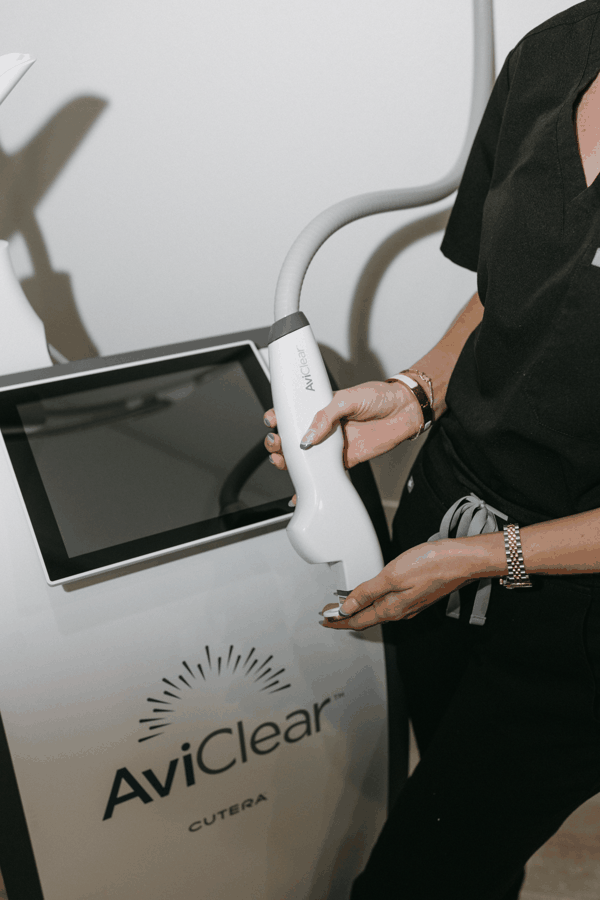
Part of choosing between a laser and a medication is knowing what the experience is, in practical terms. An AviClear session is straightforward and self-contained. After cleansing and eye protection, the handpiece passes across the treatment area in a calculated pattern. AviClear has built-in cooling, so the skin is protected as the energy is delivered, and most patients describe the feeling as a brief warmth or a light snapping sensation rather than pain. A typical session runs a contained block of time rather than a daily routine, and it treats the face as well as common areas of body acne — the back, chest, and shoulders.
Afterward, there is essentially no recovery period. Mild redness for an hour or so is typical, and then patients return to their day. There is no daily medication to remember, no dryness to manage across months, and no bloodwork between visits. For many people, that contained, in-and-out quality is a meaningful part of the appeal — the treatment fits into a calendar rather than reshaping a daily routine. We still ask every patient to maintain gentle, consistent skincare and sun protection between sessions, because supporting the skin helps it respond.
Candidacy: how we decide if AviClear is right for you
Good candidacy is the heart of an honest comparison, because the wrong tool helps no one. At consultation we look at the type of acne — inflammatory papules and pustules tend to respond well, while deep, cystic nodules may point toward medical management — and at how persistent it has been and what has already been tried. We consider whether the acne appears hormonally driven, since those patterns can re-activate and may benefit from periodic maintenance, and we factor in your skin type, your history, and your goals.
Just as important is what we rule out. AviClear treats active acne; it does not resurface skin or fill indented scars, so if your primary concern is scarring rather than active breakouts, the plan is different. And if the assessment points to severe disease, the responsible recommendation may be a referral rather than a course of laser. Confirming candidacy in person — rather than assuming it from a website — is the difference between a treatment that fits and one that disappoints. Results vary, and a careful assessment is how we keep expectations honest.
When a dermatologist and Accutane may be the better path
A balanced comparison has to say this plainly: for severe, scarring, nodulocystic acne — the deep, painful kind that can leave lasting marks — a dermatologist remains the right starting point, and oral isotretinoin may be the most appropriate treatment. There is no advantage in steering someone toward a laser when their acne genuinely calls for systemic medical management, and we will not. If your acne pattern points that way, the honest answer is a referral, not a sale.
This is not a knock on Accutane or on dermatology — both have earned their place, and isotretinoin has changed countless lives. It is simply the truth that different acne needs different tools. The value of a consultation is matching the tool to the acne, rather than fitting the acne to whatever a clinic happens to offer.
Cost, value, and how to think about the investment
Cost is a fair part of any comparison, though the two are priced in different ways. AviClear at Privé is a defined package — $3,000 for the standard three-session course in Dallas — quoted upfront so the full investment is clear before you begin, with no per-session surprises. An isotretinoin course is priced differently, through prescription and pharmacy channels that vary by coverage and circumstance, and it carries the indirect costs of monthly visits and monitoring across the months of treatment. We mention this not to claim one is cheaper, but because the shape of the spend is genuinely different, and people deserve to compare honestly.
The more useful frame is value relative to fit. The right treatment is the one that suits your acne and your life, and a well-chosen course that works is a better value than a cheaper one that does not. That is why we put candidacy ahead of conversion — a course of AviClear in someone whose acne genuinely calls for systemic management is not a bargain at any price. When AviClear is the right tool, the package buys a contained, medication-free path with durable results for many patients; when it is not, the most valuable thing we can offer is a clear referral.
How AviClear fits a longer skin plan
For most patients, clearing active acne is the beginning of the story rather than the end of it. Once breakouts are under control, the conversation usually shifts to skin quality and any residual scarring — texture, tone, and the marks acne can leave behind. AviClear does not treat scars; that is a separate problem addressed with resurfacing and regenerative tools such as SkinPen with Ariessence PDGF, and the sequence we most often recommend is to clear the active acne first, then turn to the surface. Treating scars while skin is still actively breaking out is working against a moving target.
A steady maintenance cadence — through the Luxe Skin Club or a simple consistent routine — is what keeps clear skin clear, particularly for hormonal patterns that can re-activate over time. AviClear quiets the oil glands; the rest of the plan rebuilds and protects the surface. Seen this way, the AviClear-versus-Accutane question is really the first decision in a longer arc, not the whole of it. Clear first, then refine.
How the decision is made at Privé
Every AviClear plan at Privé Aesthetics begins with a consultation that does one thing first: confirm that AviClear is the right tool for your acne. We look at your acne pattern, your history, what you have already tried, and your goals — and we will tell you honestly when a different approach, including a referral for oral therapy with a dermatologist, would serve you better. Privé is RN-led and physician-supervised by our Medical Director, Dr. Gregory Gardner, DO, and laser treatments are performed by our Licensed Laser Technician with parameters tuned to your skin type. AviClear at Privé is $3,000 for the standard three-session package — the full course the clearance data is built on, quoted upfront rather than per session.
Acne is rarely a single decision in isolation. For many patients, clearing active breakouts is step one, and the conversation then shifts to skin quality and any residual scarring through regenerative work and steady maintenance. AviClear quiets the oil glands; the rest of the plan rebuilds the skin's surface over time. Clear first, then refine.
Frequently asked
Is AviClear as good as Accutane?
They are different tools that share one mechanism — both reduce the activity of the sebaceous (oil) glands that drive acne. Accutane can be highly effective, especially for severe nodulocystic acne, but it carries systemic side effects, monthly monitoring, and strict pregnancy prevention. AviClear is a non-systemic laser that targets the oil glands locally in about three sessions, with no pill. AviClear can be an excellent option for people who cannot or prefer not to take systemic medication, and for inflammatory, hormonal, or persistent adult acne. It is not a blanket replacement, and results vary. Severe cystic acne may still warrant a dermatologist.
Can AviClear replace Accutane?
For some patients, AviClear offers a way to address acne at its source without an oral systemic medication — but it is not a universal substitute for everyone. It is often a strong fit for those who cannot take isotretinoin, who want to avoid the systemic route, or who have moderate inflammatory or hormonal acne. Severe, scarring nodulocystic acne may still be best managed by a dermatologist, who may recommend oral therapy. We assess your acne pattern at consultation and refer you when a medical route is the better path.
What is the difference between AviClear and Accutane?
Accutane is an oral systemic retinoid taken daily for months; it affects the whole body, requires monthly bloodwork, and is governed by the iPLEDGE pregnancy-prevention program. AviClear is a topical, non-systemic laser: a 1726 nm wavelength selectively suppresses the sebaceous glands from the outside in, typically across three sessions about a month apart. Both target overactive oil glands, but one does it systemically through medication and the other locally through light.
Does AviClear work for hormonal acne?
AviClear can be a good option for hormonal acne because it reduces oil-gland activity at the source rather than only managing flares. Hormonal acne can re-activate over time, so some patients choose an annual touch-up to maintain results. Results vary by individual, and we confirm candidacy at consultation.
Can I do AviClear if I am pregnant or breastfeeding?
AviClear is non-systemic, which is one reason patients ask about it as an alternative when isotretinoin is not appropriate. Because every pregnancy is individual, we ask you to disclose pregnancy or breastfeeding at consultation so we can review candidacy and timing with you. By contrast, isotretinoin is strictly contraindicated in pregnancy and is governed by the iPLEDGE program. This is general information, not medical advice — your own clinician should guide medication decisions.
How much does AviClear cost in Dallas at Privé?
AviClear at Privé is $3,000 for the standard three-session package — the full course the clearance data is built on. We quote the package upfront rather than per session, and confirm at consultation that AviClear is the right tool for your acne pattern before you commit.
How many AviClear sessions equal a course of Accutane?
They are not measured the same way. A typical Accutane course runs several months of daily oral medication; the standard AviClear protocol is three in-office sessions spaced about a month apart. The two are not interchangeable dose-for-dose, but the three-session AviClear course is the protocol its FDA clearance was built on, and is what we package.
Does AviClear have side effects like Accutane?
Because AviClear is non-systemic, it does not carry the whole-body considerations associated with oral isotretinoin, such as dryness throughout the body, lipid and liver monitoring, or pregnancy restrictions. AviClear's effects are local: most patients report a brief warm or snapping sensation during treatment, mild redness for a short time afterward, and sometimes a temporary purge in the first weeks. Any treatment has considerations, which we review with you in person.