There is a particular kind of skin question we've been hearing more often in the studio: "What is the most effective thing I can do for the texture and tone of my skin, that isn't a filler?" The honest answer, for most of the clients we see, is a protocol — not a single treatment.
Part of our complete guide to regenerative aesthetics.
The protocol we recommend most often pairs SkinPen microneedling with topical Ariessence Pure PDGF, applied in sequence, in a single appointment. This piece explains what that combination is, why we built our regenerative work around it, and what the clinical evidence actually shows.
The premise: growth factor delivery is a logistics problem
Most clients have heard of growth factors. They are signaling proteins the body uses to direct cellular repair — and the most active of them, platelet-derived growth factor (PDGF), is what platelets release at a wound site to recruit fibroblasts and start the remodeling cascade. PRP and PRF (platelet-rich plasma and platelet-rich fibrin) are autologous methods of concentrating these signals from your own blood. Ariessence Pure PDGF is a more recent development: a recombinant, bioengineered version of pure PDGF, manufactured to clinical-grade purity at a standardized concentration. The active signal, without the variability of a patient blood draw.
The catch, with any topically applied growth factor, is logistical. Skin's outermost layer — the stratum corneum — is designed to keep large protein molecules out. Topical PDGF on intact skin is, in plain language, a moisturizer with an interesting label. The molecule cannot reach the dermis where fibroblasts live. The growth factor never gets to the work.
The protocol that resolves this — and the one we use at Privé — is to create microchannels in the skin first, then apply Ariessence to the freshly treated surface. SkinPen is the microneedling system we use to make those channels. Ariessence is the growth factor we apply through them.
Why SkinPen specifically
SkinPen is the first FDA-cleared microneedling device for the face, in clinical use since 2018. We chose it as our microneedling platform for two reasons. First, the depth and pattern of the needle excursions are calibrated and consistent — meaning the microchannels are predictable, session to session, area to area. Second, the post-procedure recovery profile is mild: light pinkness for 24 to 48 hours, no downtime beyond that. Clients return to social and professional life the next day.
What SkinPen does on its own is already a meaningful treatment: it triggers a controlled wound-healing response, which builds new collagen over the following 8 to 12 weeks. The micro-injuries are small enough to heal without scarring, but real enough to recruit the body's own repair signaling. Many clients see real texture and tone improvement from SkinPen sessions alone.
What Ariessence adds is the amplification of that response. The body's own PDGF release is part of what makes microneedling effective; Ariessence supplements that release with a clinical-grade concentration of the same molecule, delivered through the microchannels in the moments they're most receptive.
The clinical evidence we trust
The strongest available evidence for this approach is the Gold 2025 randomized controlled trial, published in September 2025. The study evaluated topical recombinant human PDGF-BB applied immediately after a single session of Morpheus8 radiofrequency microneedling, compared against a bland emollient control. At 30 days, the PDGF group showed statistically significant improvement on the Clinical Global Aesthetic Improvement Score and favorable performance on six of seven Canfield Visia skin-quality metrics, with no serious adverse events.
We track this evidence base honestly. The Gold trial used Morpheus8 specifically; SkinPen is a different platform but creates the same type of microchannels. The formulation evaluated in the trial is closely related to, but not identical to, the marketed Ariessence Pure PDGF+ product. We discuss these nuances with clients in consultation rather than over-claiming. The body of clinical work supports the methodology — topical PDGF post-microchannels — and that is what we offer.
What the protocol looks like in our studio
A SkinPen + Ariessence session is 60 to 90 minutes from start to finish.
The first 15 to 20 minutes are a clean, slow start — makeup off, cleanse, topical numbing applied. Numbing matters; SkinPen is tolerable without it, but the calmer the experience, the better the outcome and the more relaxed the client. We don't rush this part.
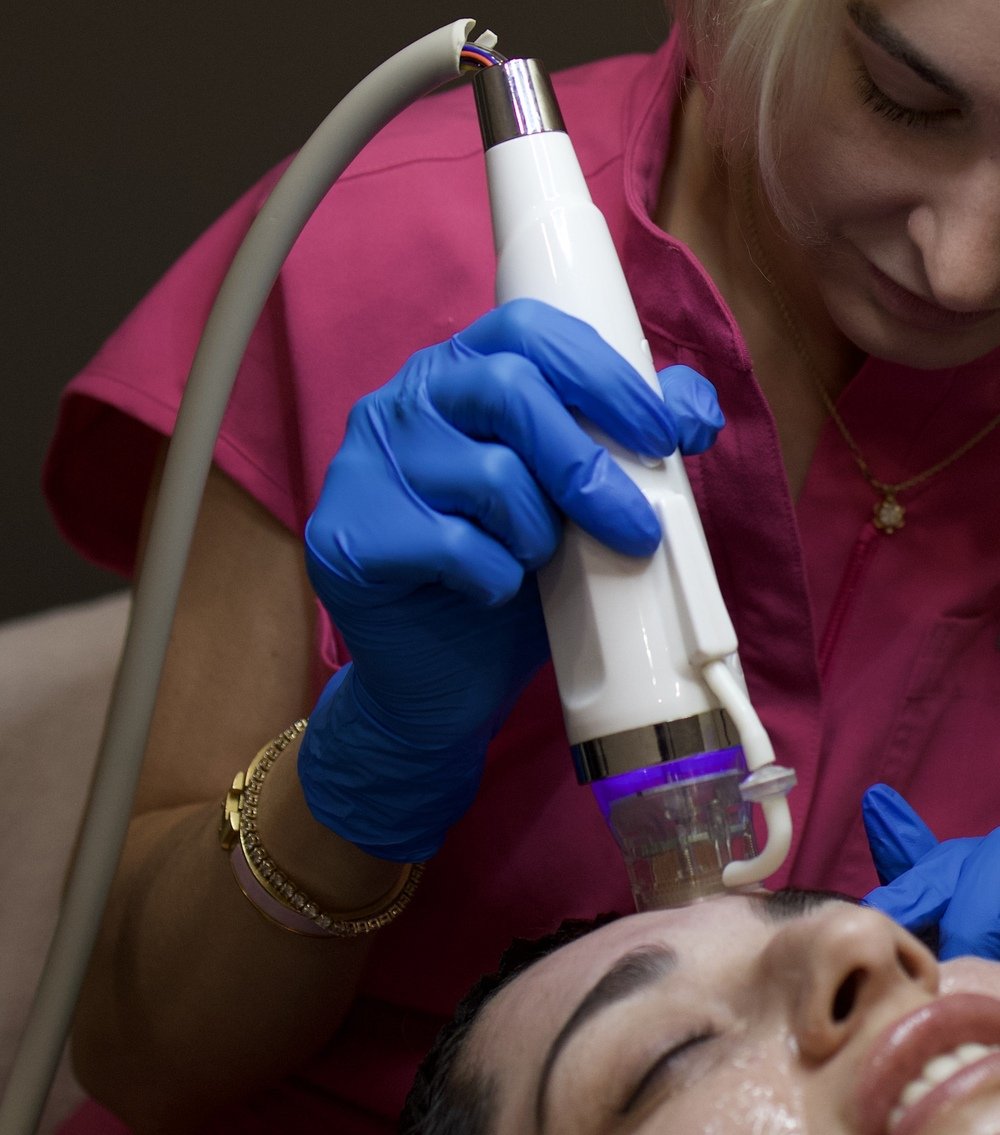
The microneedling pass takes another 15 to 20 minutes depending on the areas treated. The full face is most common; we also treat neck, décolleté, and the dorsal hands when those are part of the plan. The pass is methodical, area by area, with depth adjusted for each zone. Lighter on the eyelid skin, deeper on areas with established scarring or texture.
Immediately after the pass — while the microchannels are still freshly open — Ariessence Pure PDGF is applied topically to the treated skin. The growth factor absorbs through the channels into the upper dermis, where fibroblasts begin to signal. The application takes only a few minutes; the absorption happens during the next ten or so. A cool compress finishes the session.
Clients leave with calm, slightly pink skin. The look at hour one is essentially the same as a SkinPen session on its own — the growth factor finish is invisible. Most clients return to dinner plans the same evening with mineral SPF and gentle skincare. Light redness and warmth resolve over 24 to 48 hours.
What changes, and over what timeline
The visible improvement is gradual on purpose. Skin tone clarifies first, over the first two to four weeks. Fine-line softening and texture refinement build between weeks four and twelve as new collagen organizes. Most clients can clearly see the difference in photographs at week eight, comparing to baseline.
For most clients, we recommend a series of two to three sessions, four to six weeks apart, then maintenance every six to nine months. The cadence isn't arbitrary — it tracks the collagen remodeling cycle, which takes roughly 28 days to complete a turnover and 8 to 12 weeks to reorganize. Working with that timeline produces compounding results; against it, you start each session from a half-built foundation.
Where this protocol fits — and where it doesn't
SkinPen + Ariessence is our recommendation for skin-quality work: under-eye texture and tone, periorbital crepiness, mid-face skin quality, neck and décolleté texture, hand rejuvenation, and as adjunctive support after laser or other resurfacing. It is not a substitute for volume restoration. Clients who present with deep volume loss in the cheeks or temples need a different conversation — likely Sculptra, EZGel, or dermal filler depending on the situation.
The two protocols are complementary, not competitive. A client with both texture concerns and volume concerns typically receives a year-long plan that includes volume work and skin-quality work, sequenced for the best total result.
The honest summary
There is a lot of marketing in our industry that treats new ingredients and new devices as standalone miracle workers. Ariessence is a meaningful advance in regenerative aesthetics, but it does its work as part of a protocol — not a product on a shelf. The protocol is the SkinPen, the timing, the post-care, and the cadence of the series, with the growth factor as the amplifier inside that container.
We built our regenerative practice around the protocol because it is, at present, the most clinically defensible and consistently effective way to deliver this category of treatment. Whether it is the right choice for any given client is a consultation conversation; the variables are individual.
If you have been considering microneedling or have been told you should be doing something about under-eye texture or fine lines, this is the protocol we would talk through with you.