Every September the same appointment fills our book: a patient sits down, tilts toward the window, and says some version of where did all of this come from. The honest answer is that it came from the last four months of Dallas sun, and the useful answer is that there are three credible ways to address it — and they are not interchangeable.
Part of our complete guide to skin rejuvenation.
Light-based treatment, chemical exfoliation, and fractional resurfacing all reduce visible brown pigment. They do it by different mechanisms, on different timelines, with different amounts of downtime, and with meaningfully different risk profiles depending on your skin type. Choosing among them is not a matter of preference. It is a matter of correctly identifying what is on your face first, and then matching the modality to it.
What follows is the same comparison we walk through in the consultation room in Highland Park. It is written to help you arrive informed rather than to substitute for the assessment itself.
First, identify what you actually have
Not all brown is the same brown. Four things get called sun spots in casual conversation, and they respond very differently to treatment.
Solar lentigines — true sun spots. Flat, well-defined, tan to dark brown, usually on the cheeks, temples, forehead, chest, hands, and forearms. They have distinct borders and they do not fade meaningfully in winter. These are accumulated ultraviolet damage: melanocytes in the epidermis that have been chronically stimulated and now overproduce pigment in a fixed footprint. They are the most straightforward category to treat.
Ephelides — freckles. Smaller, lighter, genetically driven, and sun-reactive. They darken in summer and fade in winter. They can be lightened, but they will return with sun exposure because the underlying tendency does not go away.
Melasma. Larger, symmetric, blurred-edged patches, most often across the cheekbones, upper lip, forehead, and jawline. It is driven by hormones and heat as much as by light, and it involves a deeper and more reactive process than sun damage does. Melasma is a chronic condition to be managed, not a spot to be erased. This distinction matters enormously, because the wrong treatment does not simply fail on melasma — it can make it worse. Aggressive light or heat can trigger a rebound in which pigment lifts briefly and then returns darker and more diffuse than it started. We have written about that separately in our guide to melasma treatment in Dallas.
Post-inflammatory hyperpigmentation. Brown marks left behind by acne, an ingrown hair, a scratch, a burn, or a prior procedure. They follow the shape of whatever caused them. PIH often resolves on its own over months, and it responds well to patient, gentle intervention — and poorly to anything that reintroduces inflammation.
If you cannot confidently sort your own pigment into one of those categories, that is not a failure on your part. It is precisely why the first step at Privé is an assessment rather than a booked treatment. We look at borders, symmetry, distribution, seasonal behavior, hormonal history, and your Fitzpatrick skin type before anything is recommended.
Option one — IPL / AFT photofacial
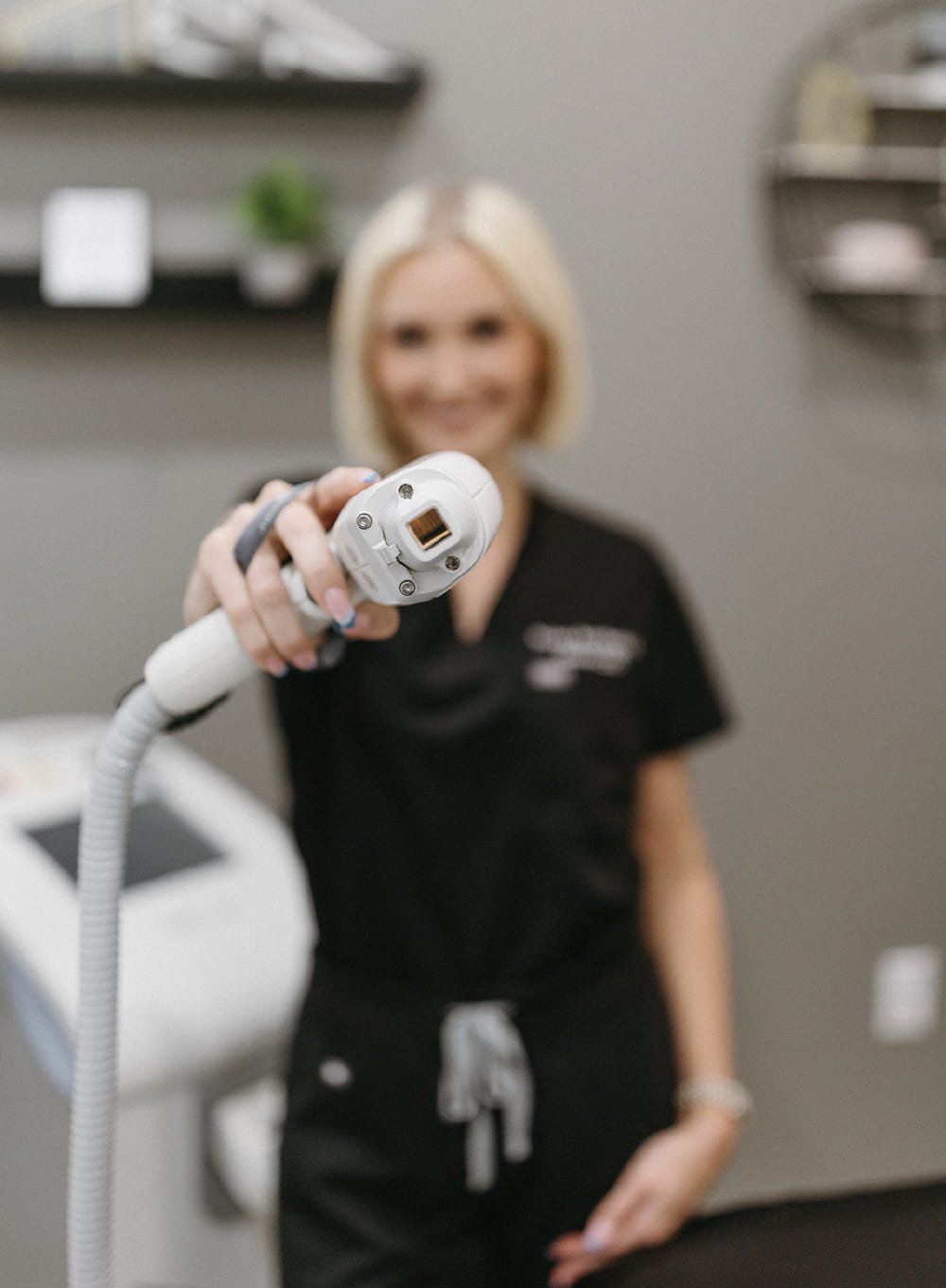
Our IPL photofacial is delivered on the Alma Harmony XL using AFT — Advanced Fluorescence Technology, Alma's refinement of conventional intense pulsed light. Rather than a single laser wavelength, IPL emits a filtered band of light. That broadband energy is preferentially absorbed by darker chromophores in the skin: melanin in a brown spot, and hemoglobin in a broken capillary. The absorbed light converts to heat, the pigment is fragmented, and the skin clears it out.
The characteristic thing patients notice is what we call the coffee-grounds effect. Within a day or two, treated spots go darker, not lighter — taking on a peppery, granular look. That is the treated pigment migrating toward the surface. Over the following week to two weeks the spots micro-flake away and the skin underneath reads clearer. It is briefly conspicuous, and then it is done.
Photofacial is planned as a series, typically three to five sessions spaced three to four weeks apart, because each pass addresses a portion of the pigment load rather than all of it. Social downtime is minimal — most patients return to normal activity the same day, with mild warmth and pinkness for a few hours. Makeup is generally fine the next day.
Where IPL is excellent: discrete brown spots and diffuse redness on lighter skin types, particularly when both appear together. Where it requires caution: an active tan or recent significant sun exposure, higher Fitzpatrick skin types, and any suspicion of melasma. A tan is competing pigment, which is why we ask patients to come in untanned. Our longer piece on what IPL treats and how it feels covers the experience in more detail.
Option two — chemical peels
A chemical peel works on entirely different physics. Instead of selectively heating pigment, a peel applies acid to the skin surface to break the bonds between cells and drive controlled, accelerated exfoliation. Pigment held in the upper layers sheds along with those cells, and the accelerated turnover encourages more even melanin distribution as the skin rebuilds.
We work across a range of formulations. Superficial peels — glycolic, salicylic, lactic, mandelic — act within the epidermis, produce light flaking, and are designed to be repeated. A Jessner's peel combines resorcinol, salicylic acid, and lactic acid, and is particularly useful for uneven tone and congestion. TCA, trichloroacetic acid, reaches deeper depending on concentration and technique and is used where more decisive correction is warranted.
Because a peel is not targeting a chromophore, it does not care whether your pigment is a discrete spot or a broad haze. That makes it the better instrument when tone is diffuse — dullness, blotchiness, a general muddiness across the cheeks — rather than dotted. It is also the more appropriate route when light-based treatment carries elevated risk: higher Fitzpatrick types, melasma-prone skin, and patients who need pigment work without heat.
Downtime scales with depth. A superficial peel usually means two or three days of tightness and light flaking. A medium-depth peel means visible peeling for roughly five to seven days and a real commitment to sun avoidance afterward. Superficial peels are typically planned as a series of four to six; deeper peels are single events with longer intervals. Our chemical peel guide details how we choose the depth.
Option three — fractional resurfacing
Fractional resurfacing at Privé is performed on the Alma Harmony XL using the 2940 nm Er:YAG handpiece, delivered in the fractional iPixel mode. Erbium at 2940 nm is absorbed almost entirely by water, which means it ablates tissue precisely with comparatively little residual heat spread. Fractional delivery means the beam is split into a grid of microscopic treatment columns, leaving untreated skin between them to act as a healing reservoir — which is what makes meaningful resurfacing possible without treating the entire surface at once.
That mechanism does two things at once. It removes pigmented tissue directly, and it initiates a wound-healing and collagen-remodeling response in the columns and the tissue around them. So resurfacing is the answer when brown spots are not the only complaint — when pigment arrives alongside crepey texture, enlarged pores, fine lines around the eyes and mouth, or shallow scarring. You can read more on our skin rejuvenation page.
It also demands the most from you. Expect several days of visible healing: pinkness, a sandpapery texture, swelling in the first forty-eight hours, and strict sun avoidance during recovery. In exchange, resurfacing generally requires the fewest sessions — often one to three — because each treatment does substantially more work than a photofacial pass or a superficial peel.
One point of accuracy, because patients ask what is actually in the room: our resurfacing is erbium-based, performed on the Alma Harmony XL. Ablative resurfacing platforms differ considerably in how much residual heat they leave behind and therefore in how recovery unfolds, so we would rather name the specific handpiece than describe the category loosely. If you have had resurfacing elsewhere, tell us which platform — it informs how we plan yours.
Comparing the three side by side
IPL / AFT photofacial (Alma Harmony XL). Best for discrete brown spots and diffuse redness. Downtime: minimal, with visible darkening and flaking of treated spots for roughly one to two weeks. Sessions: typically three to five. Skin types: best suited to lighter Fitzpatrick types; not a default choice for higher types or for melasma-prone skin.
Chemical peel (superficial through medium; Jessner's, TCA). Best for diffuse uneven tone, dullness, congestion, and pigment where heat and light are inadvisable. Downtime: two to three days for superficial, five to seven for medium-depth. Sessions: four to six for superficial series; fewer for medium. Skin types: adaptable across a wider Fitzpatrick range with appropriate formulation, concentration, and priming.
Fractional resurfacing (Alma Harmony XL, 2940 nm Er:YAG / iPixel). Best for pigment accompanied by texture, fine lines, pores, or scarring. Downtime: several days of visible healing, longest of the three. Sessions: fewest, often one to three. Skin types: candidacy assessed carefully; higher Fitzpatrick types require conservative parameters and thorough priming.
Results vary in every category. These ranges describe how we plan, not what we promise.
What we choose for darker skin
This deserves its own section because it is where the industry most often gets it wrong. In Fitzpatrick IV through VI skin there is more baseline melanin throughout the epidermis, which means light-based treatment has far more to interact with than the target spot alone. The consequences of misjudging that are not cosmetic disappointments — they are post-inflammatory hyperpigmentation, hypopigmentation, and in the worst cases burns, any of which can outlast the original concern by many months.
So for higher Fitzpatrick types we do not reach for IPL as a routine solution to brown spots. The safer sequence generally begins with a disciplined topical and photoprotection regimen, adds carefully selected superficial peels with appropriate priming, and where remodeling is wanted, uses RF microneedling on the Timeless Evolution. RF microneedling delivers radiofrequency energy through insulated needles into the dermis rather than through melanin in the epidermis — which is precisely why it is a more forgiving option across a broader range of skin tones. Solta's Clear + Brilliant is another gentle, gradual route we use for tone refinement.
Candidacy is always determined at consultation, and all treatment at Privé is performed under the medical supervision of Medical Director Dr. Gregory Gardner, DO. Being told that a popular treatment is not right for your skin is not a lesser outcome. It is the treatment plan working correctly.
Why fall is the right season
All three modalities share the same seasonal logic. Each of them either targets pigment or removes surface tissue, and each leaves skin temporarily more photosensitive. Recent sun exposure raises the risk going in, and further sun exposure undermines the result coming out.
Dallas gives us a real window from roughly late September through March. UV index drops, tans fade, and the daily incidental exposure of a Texas summer — the walk across the parking lot, the patio lunch, the Saturday at the lake — largely disappears. Starting a three-to-five-session photofacial series in October means finishing before spring. Starting a peel series now means the cumulative effect has arrived by the time you actually want it. And resurfacing recovery is far easier to protect in November than in July.
Daily broad-spectrum SPF 30 or higher is non-negotiable through all of it, in every season, regardless of skin tone. Without it, the pigment simply comes back, and no device changes that.
What happens at consultation
We assess your skin in person and under proper lighting, classify your Fitzpatrick type, and categorize the pigment itself — lentigines, freckles, melasma, PIH, or some combination, because combinations are common. We review your history: hormonal factors, pregnancy, oral contraceptives, medications that increase photosensitivity, prior treatments and how your skin responded, and your recent sun exposure.
From there we recommend a modality or a sequence, and we tell you plainly what the downtime looks like and what a realistic timeline is. Where topical support belongs in the plan, we build it in — including topical Ariessence, which at Privé is used as a topical serum alongside procedures and is never framed as anything other than topical. If your skin is not a good candidate for what you came in asking about, we will say so and offer what is appropriate instead.
Nothing here is a guarantee of outcome. Results vary by individual, and the final plan is determined at consultation.
Frequently asked
Which treatment is best for sun spots?
For discrete, well-defined brown spots (solar lentigines) on lighter skin types, IPL photofacial on the Alma Harmony XL is usually the most efficient first choice — it targets individual spots with broadband light and typically needs little to no social downtime. When pigment is diffuse rather than spotted, a chemical peel often serves better. When pigment sits alongside texture, pore size, or fine lines, fractional resurfacing with the Alma Harmony XL 2940 nm Er:YAG handpiece addresses both in fewer sessions. Results vary by individual, and the right modality is determined at consultation after your skin is assessed in person.
Will IPL work on my melasma?
Caution is warranted. Melasma is a hormonally and heat-influenced pigment condition rather than simple sun damage, and light-based treatment can flare it — pigment may lift briefly and then return darker than before. For that reason we do not treat suspected melasma with IPL as a default. Melasma is managed as a long-term condition with topical therapy, strict photoprotection, gentle modalities, and carefully selected superficial peels. If there is any question whether pigment is melasma or sun damage, we assess before treating rather than after.
Is IPL safe for darker skin?
Broadband light targets pigment, and in Fitzpatrick IV through VI skin there is more background pigment for that light to interact with — which raises the risk of post-inflammatory hyperpigmentation, hypopigmentation, or burns. At Privé we do not treat higher Fitzpatrick types with IPL as a routine approach to brown spots. We favor gentler, pigment-sparing routes instead: topical regimens, conservative superficial peels, and RF microneedling on the Timeless Evolution, which delivers energy through insulated needles rather than through melanin. Candidacy is determined at consultation under physician-supervised protocols.
How many sessions will I need?
As a general guide, IPL photofacial is planned as a series of three to five sessions spaced roughly three to four weeks apart. Superficial chemical peels are typically planned as a series of four to six, spaced two to four weeks apart; medium-depth peels require far fewer. Fractional resurfacing generally requires the fewest sessions — often one to three — because each pass does more work. Your actual plan depends on how much pigment is present, how deep it sits, your skin type, and how your skin responds. Results vary and the final plan is determined at consultation.
How long until the spots fade?
After an IPL photofacial, treated spots typically darken within a day or two — the coffee-grounds effect — then flake away over roughly seven to fourteen days. After a superficial peel, visible shedding usually occurs across days three through seven, with tone continuing to even over the following weeks. After fractional resurfacing, surface healing generally takes several days, with pigment and texture continuing to refine over one to three months as new collagen forms. Cumulative improvement across a full series is the realistic expectation rather than a single dramatic result. Results vary by individual.
Can I combine treatments?
Often yes, when they are sequenced rather than stacked. A common approach is to clear discrete sun spots with a photofacial series first, then maintain tone with periodic superficial peels and a disciplined topical regimen. Fractional resurfacing is typically scheduled as its own event with adequate healing time on either side. Treatments are not combined in the same visit without clinical reason, and any combined plan at Privé is built at consultation and carried out under the medical supervision of Medical Director Dr. Gregory Gardner, DO.