Laser360 is not a single laser. It is a staged protocol on the Alma Harmony XL platform that layers three different energies across a planned series — AFT broadband light for colour, 1320 nm non-ablative infrared for firmness, and 2940 nm Er:YAG fractional resurfacing for texture. RN-led, physician-supervised, and mapped to the individual at consultation.
Part of our complete guide to skin rejuvenation.
Almost nobody walks into a consultation with one problem. They walk in with a photograph taken in unforgiving light and a sentence that begins, "I don't know exactly what it is, but…" — and what follows is usually three things at once. Brown patches across the cheekbones. A slackness along the jaw that was not there five years ago. A roughness in the skin that makeup now sits on top of rather than settling into. This piece explains the protocol we reach for when the answer genuinely is all three, and why we run it as a series rather than an appointment.
The problem with treating one thing at a time
Skin is layered, and so are its complaints. Pigment and vascular redness live largely in the upper layers, where they are visible as colour. Laxity is a dermal issue — a matter of collagen architecture several millimetres down. Texture, meaning fine lines, enlarged pores, and the roughness of accumulated sun exposure, is a property of the surface itself. Three concerns, three different depths, three different physical problems.
Every device on the market is good at one of those layers. That is not a criticism; it is physics. A given wavelength is absorbed by a particular target at a particular depth, and that specificity is exactly what makes it safe and effective. But it also means that treating a single layer well leaves the other two untouched. A patient who does a course of light-based treatment gets clearer colour and is then disappointed that the skin still feels rough. A patient who does a resurfacing treatment gets smoother texture and is puzzled that the brown spots came back. Neither treatment failed. Each did precisely what it was designed to do.
The honest version of that conversation is: you are describing more than one problem, and one modality is not going to solve all of it. What we can do is plan the order.
What Laser360 is
Laser360 is Alma's combination protocol, delivered on the Harmony XL platform. It layers three distinct energy types — broadband light, non-ablative infrared, and fractional ablative resurfacing — in a deliberate sequence across a planned series of appointments, so that colour, firmness, and texture are addressed together rather than chosen between.
The Harmony XL is a modular platform: a single system with interchangeable handpieces, each delivering a different wavelength for a different clinical purpose. Laser360 makes structured use of that modularity. Instead of booking three unrelated treatments over an indefinite period and hoping they add up, the protocol defines which energies go in which order, how far apart, and how the skin should be behaving before the next layer is added.
Parameters — the specific settings for each layer — are set per protocol and according to skin type, the concerns being treated, and how your skin has responded to prior sessions. We do not publish numbers, because published numbers invite comparison shopping on a variable that should be decided in the treatment room by the person holding the handpiece.
Layer one — AFT for pigment and redness
AFT stands for Advanced Fluorescence Technology, Alma's refinement of broadband light. It works in the same family as a conventional IPL photofacial: pulses of filtered light are absorbed preferentially by melanin in sun-induced pigment and by haemoglobin in dilated superficial vessels. The absorbed energy heats those targets selectively, leaving the surrounding skin comparatively unaffected.
What patients notice first is that treated pigment gets darker before it gets better. That is expected: the damaged pigment rises toward the surface as coffee-ground flecks over the following days and sheds with normal skin turnover. Vascular redness responds differently — treated vessels tend to fade rather than flake. Diffuse background flushing typically softens gradually across a series rather than disappearing after one pass.
Colour is treated first for a practical reason. It is the change patients see soonest, and clearing the surface pigment gives a truer read on what is left underneath — how much of the "tiredness" was pigment, and how much was actually laxity or texture. If you want the longer comparison of light-based treatment against other approaches, we wrote about it in detail in our piece on sun damage, redness, and brown spots.
Layer two — 1320 nm non-ablative infrared for collagen and firmness
The second layer is a 1320 nm Nd:YAG infrared wavelength, and it does something entirely different. At 1320 nm the energy is absorbed principally by water in the dermis, which means it passes through the surface and deposits heat in the deeper collagen-bearing tissue below.
Non-ablative is the word that matters here. It means no tissue is removed. The epidermis stays intact; the treatment is a controlled deep heating rather than a controlled injury to the surface. That heat raises dermal temperature enough to signal fibroblasts — the cells responsible for producing collagen — to begin a wound-healing and remodelling response without any wound at the surface at all.
The practical consequence is that this is the layer with the least visible downtime and the slowest visible payoff. Patients typically leave warm and flushed and look ordinary again within hours. Nothing peels. Nothing crusts. And nothing dramatic happens for weeks, because collagen remodelling is a biological timeline measured in months, not days. If you have read our comparison of SkinPen, RF microneedling, and fractional laser, this is the same principle at work: the treatments that stimulate collagen deliver on a delay, and impatience is the most common reason people abandon them one session before the results arrive. RF microneedling reaches a similar goal by a different route, and for some patients it is the better instrument — that is a consultation decision.
Layer three — 2940 nm Er:YAG fractional resurfacing for texture
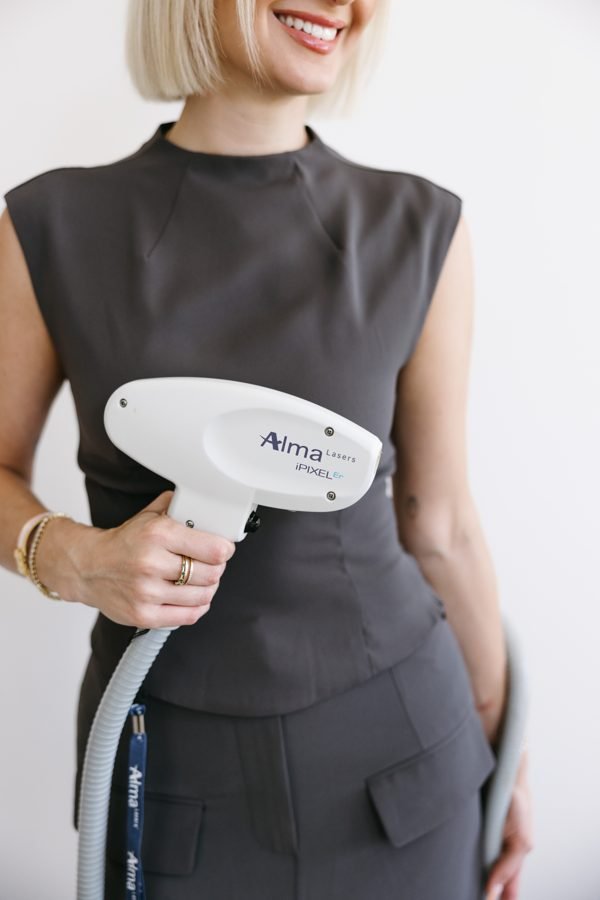
The third layer is 2940 nm Er:YAG delivered fractionally — Alma calls this handpiece iPixel. Er:YAG is very strongly absorbed by water, which makes it a precise ablative wavelength: it removes a thin column of tissue cleanly, with a narrow zone of residual heat around it.
Fractional means the beam is divided into a grid of microscopic treatment columns, so only a fraction of the surface area is ablated in any one pass. The untreated skin bridging those columns acts as a reservoir of healthy tissue that drives rapid re-epithelialisation. That is the compromise that made fractional resurfacing the standard: meaningful surface renewal, without the extended recovery of a fully ablative treatment. To be clear, Privé does not offer a fully ablative resurfacing device — our resurfacing work is fractional. You can read more on the fractional resurfacing service page.
This is the layer with real downtime, and we say so plainly at consultation rather than after. Expect notable redness, a distinctly sandpaper-like texture as the treated columns dry down, and several days of flaking and peeling. Makeup is generally off the table for the first stretch. Sun exposure is off the table for considerably longer. The recovery is manageable and predictable, but it is not nothing, and it belongs on a calendar with a clear week or two after it. Individual recovery varies.
Why sequence and spacing matter
The temptation, always, is to compress. Patients ask whether all three layers can be done in one long afternoon, and the answer is no — not because of scheduling, but because each layer is asking the skin to run a healing process, and stacking those processes on top of each other raises inflammation without improving the result. Inflammation is the mechanism behind most laser complications, pigment among them.
So the series is spaced. Enough time between appointments for the barrier to restore, for post-treatment redness to settle, and for us to see how your skin actually behaved before deciding what the next layer should look like. That last point is the one clinicians care about most: the second session is informed by the first. A patient whose pigment lifted beautifully and whose skin calmed quickly gets a different plan from a patient who stayed pink for a fortnight.
The other reason spacing matters is the collagen timeline. Dermal remodelling from the infrared layer continues quietly for months after the appointment itself. A series structured over a season is not a scheduling inconvenience — it is roughly the pace at which the biology delivers. Results vary, and they accrue rather than arrive.
Who it suits, and who it does not
Laser360 tends to suit adults with layered sun damage — visible pigment, some background redness, early to moderate laxity, and textural change — who want a coordinated plan rather than a sequence of one-off treatments, and who can commit to a series and to the aftercare between sessions. It suits people who are realistic about a months-long arc and who are prepared to be diligent about sun protection throughout.
It is not the right choice for everyone. Higher Fitzpatrick skin types require careful assessment. Light-based and laser energy carries a higher risk of post-inflammatory hyperpigmentation in richly pigmented skin, and the AFT broadband light layer in particular warrants candid evaluation before it is used. That is not an automatic exclusion — it is a reason for an in-person assessment that covers Fitzpatrick typing, any history of melasma or post-inflammatory pigment, recent and habitual sun exposure, and current medications. In some cases the appropriate plan modifies a layer, omits one, or takes a different path entirely.
Also not appropriate: anyone recently or actively tanned, anyone pregnant or breastfeeding, anyone with active infection or inflammatory skin disease in the treatment area, anyone taking photosensitising medication, and anyone with a recent history of isotretinoin. Candidacy for medically appropriate candidates is determined at consultation, and every plan runs under physician supervision.
Why fall and winter are the right window
Laser-treated skin is more photosensitive during a series, and sun exposure between sessions is the single most reliable way to undo the work — both by re-depositing the pigment that was just cleared and by raising the risk of unwanted post-treatment pigment. In Dallas, that argument is not theoretical. Beginning in September or October means the series runs through the lowest-UV stretch of the year, when hats and sleeves are natural rather than a discipline.
The timing works for the biology as well. A series begun in autumn has its collagen response still building through winter and into spring, which is roughly when patients start looking at themselves in brighter light again. It also means the downtime lands in the season when a quiet week is easiest to arrange.
What to expect
A consultation first — skin assessment, Fitzpatrick typing, history, and an honest conversation about which concerns this protocol addresses well and which it does not. From there, a mapped series with the layers, the order, and the spacing set out in advance, alongside the broader skin rejuvenation plan the protocol sits inside.
Downtime by layer: minimal for the non-ablative infrared, a few days of darkening and flaking pigment after the light layer, and several days of visible redness and peeling after the fractional resurfacing. Aftercare is non-negotiable throughout — barrier support, disciplined sun avoidance, and daily broad-spectrum protection, which is what keeps a good result a good result.
Results build over months rather than appearing at the end of an appointment, and they vary between individuals. We do not promise a specific outcome, because the responsible answer is that it depends on your skin, your history, and what you do between sessions. What we do commit to is a protocol planned in advance, adjusted as we go, and run by clinicians who will tell you when a different treatment is the better answer.
Frequently asked
What is Laser360?
Laser360 is a staged combination protocol delivered on the Alma Harmony XL platform. Rather than one energy applied once, it layers three different technologies across a planned series: AFT broadband light for pigment and vascular redness, 1320 nm non-ablative infrared for deep dermal heating and firmness, and 2940 nm Er:YAG fractional ablative resurfacing for surface texture. At Privé Aesthetics in Highland Park, Dallas, the protocol is RN-led and physician-supervised by Medical Director Dr. Gregory Gardner, DO. Candidacy, the number of sessions, and the order of layers are determined at consultation. Results vary.
How is Laser360 different from a single laser treatment?
A single modality addresses one layer of the skin well. Light-based treatment targets colour; non-ablative infrared targets dermal collagen; fractional ablative resurfacing targets the surface. Most complaints about skin quality involve more than one of those at once. Laser360 sequences all three across a series so colour, firmness, and texture are addressed in a planned order rather than chosen between. Whether a combination protocol or a single modality is more appropriate is determined at consultation for medically appropriate candidates.
How many Laser360 sessions will I need?
Laser360 is designed as a series rather than a single appointment, typically spaced several weeks apart to allow recovery between layers. The exact number of sessions and the spacing between them depend on skin type, the concerns being treated, and how the skin responds along the way. Your plan is mapped at consultation and adjusted as the series progresses. Results vary and build over months as collagen remodels.
How much downtime does Laser360 involve?
Downtime differs by layer. The AFT light layer typically involves warmth and mild redness, with treated pigment darkening and flaking off over the following days. The 1320 nm non-ablative infrared layer removes no surface tissue, so downtime is generally minimal — warmth and flushing that settle quickly. The 2940 nm Er:YAG fractional layer is the ablative step and carries real, manageable downtime: redness, a sandpaper texture, and peeling over several days. Sun avoidance and diligent aftercare are required throughout. Individual recovery varies.
Is Laser360 safe for darker skin tones?
Light-based and laser energy carries a higher risk of post-inflammatory hyperpigmentation in higher Fitzpatrick skin types, and the AFT broadband light layer in particular requires careful assessment. That does not automatically exclude anyone, but it does mean a candid in-person evaluation is essential: Fitzpatrick typing, history of melasma or post-inflammatory pigment, recent sun exposure, and current medications are all reviewed. In some cases we recommend modifying the protocol, omitting a layer, or choosing a different treatment path entirely. Candidacy is determined at consultation and every plan is physician-supervised.
When should I start Laser360?
Fall and winter are the practical window. Treated skin is more photosensitive during and after a laser series, and sun exposure between sessions raises the risk of unwanted pigment. Starting in the cooler months means the series runs during the lowest-UV stretch of the Dallas calendar, with the collagen response continuing to build over the months that follow. Beginning in autumn also means the series is behind you before the next high-sun season. Timing is confirmed at consultation.