
People spend years protecting their face and then notice, one morning, that their chest looks ten years older than their cheeks. It is almost always the same story: SPF stopped at the jawline.
Part of our complete guide to skin rejuvenation.
Why these three age first
- Thinner skin. The neck and chest have less oil and fewer supporting structures than the face.
- Constant exposure. Hands get sun every time you drive. The chest gets it every time you wear an open neckline.
- Missed by routines. Serums, retinoids and sunscreen usually end at the chin.
What shows up is predictable: freckling and brown spots across the chest, redness and a mottled texture on the sides of the neck, and spots on the backs of the hands.
What helps
IPL on our Alma Harmony XL targets pigment and visible redness with broad-spectrum light. Brown spots darken and flake off over a week or two; redness fades over a series. It is well suited to the chest and hands, where sun damage is typically spread out rather than concentrated.
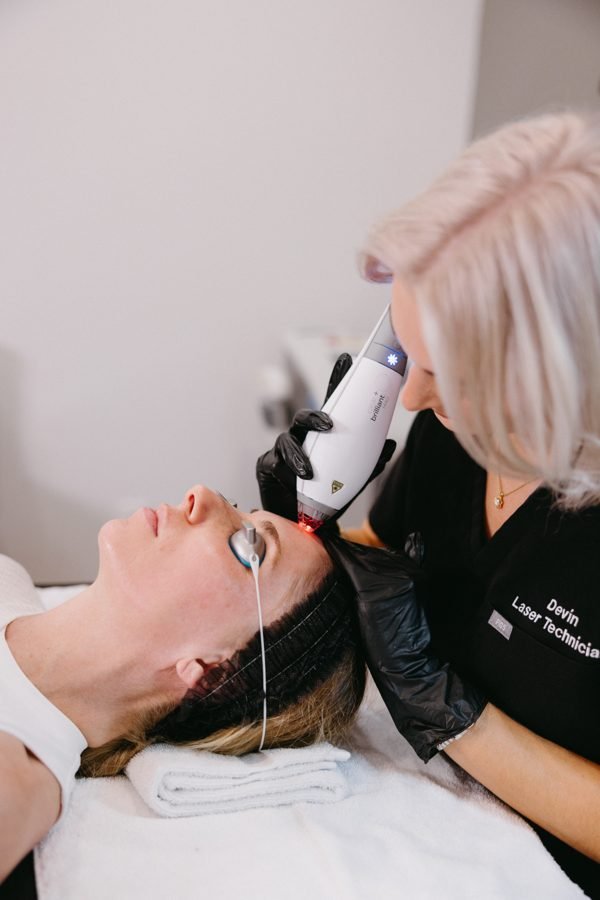
Clear + Brilliant is a gentle, non-ablative fractional laser that improves tone and texture with very little downtime. It is a good choice for the neck, where skin is delicate and people want results without looking treated.
Sun damage on the chest isn't a separate problem from your face. It's the same problem, on the skin nobody was protecting.Privé Aesthetics
Why now
Light-based pigment treatment needs skin that isn't tanned — the light cannot tell the difference between a sun spot and a summer tan. Fall is when the chest and hands finally stop getting daily exposure, which makes October through February the right window.
A typical plan is two to three IPL sessions a month apart, sometimes followed by Clear + Brilliant for texture.
The part that keeps it
Sunscreen to the collarbones and the backs of the hands, every day, all year. Without it, the result slowly reverses. With it, it holds. That is not a sales line — it is the whole maintenance plan, and it costs almost nothing.
A note on deeper skin tones
IPL on Fitzpatrick IV and above is spot-treatment only here, never full-field, because the risk of pigment change is real. That is a clinical rule, not a preference, and it is part of why your skin type is assessed before anything is scheduled.