Every September the same conversation happens in our consultation room: someone sits down, points at a cheek, and asks why we could not have done this in June. The answer is not scheduling and it is not marketing — it is that light-based treatments and ultraviolet exposure are working on the same target, and in a North Texas summer, UV wins.
Part of our complete guide to skin rejuvenation.
Laser and light-based treatment has a season in Dallas. Not because the devices behave differently in October, but because your skin does. The variable that determines whether a resurfacing treatment produces a clean, even result or an unwelcome patch of pigment is not the machine — it is how much sun the skin has absorbed in the weeks before, and how much it will absorb in the weeks after. In a city where the UV index sits at extreme through most of June, July, and August, and where the practical reality is pool afternoons and unshaded parking lots, that variable is very hard to control. In November it is close to trivial.
This is the piece we hand to patients who want to understand the reasoning rather than just be told to wait. It covers the actual mechanism, why Dallas is a more extreme case than most of the country, which treatments open up in autumn, why starting now is really about next spring, what stays available year-round, and the one rule that does not change with the calendar.
The real reason lasers and sun don't mix
Nearly every aesthetic laser and light device works on the same principle: selective photothermolysis. Energy at a specific wavelength is delivered into the skin, absorbed preferentially by a particular target — melanin, hemoglobin, water — and converted to heat, which produces a controlled injury the body then repairs. The precision of the treatment depends entirely on the energy going where it is supposed to go.
Recent sun exposure interferes with that in two directions.
Before treatment. A tan — even a light one you would not describe as a tan — means elevated melanin distributed through the epidermis. For any device that targets pigment, that extra melanin behaves as unintended competing chromophore. Energy intended for a discrete brown spot or a hair follicle is instead absorbed diffusely across the surface. The practical consequences are burns, blistering, and unpredictable results. This is why a responsible provider will ask about recent sun exposure and will postpone rather than proceed, and why the safest interval is typically several weeks of genuine sun avoidance before a pigment-targeting session.
After treatment. Freshly treated skin is in an inflammatory healing state, and inflamed skin is primed for post-inflammatory hyperpigmentation — the melanocyte response that lays down excess pigment in a spot that was recently irritated. UV exposure during that window is one of the most reliable triggers. It is a particularly frustrating outcome because it can be worse than the pigment that prompted treatment in the first place, and it can take months to resolve.
Skin type matters here. Higher Fitzpatrick phototypes — deeper, more melanin-rich skin — carry a meaningfully higher baseline risk of post-inflammatory hyperpigmentation from any thermal injury, seasonal or not. For those patients we generally favor radiofrequency microneedling, which creates its thermal effect through energy that is not absorbed by melanin, over aggressive light-based approaches. That is a clinical judgment made at consultation, not a rule we apply from a chart.
Why Dallas specifically
Plenty of practices talk about laser season. In North Texas the argument is simply sharper.
Dallas summers are long and genuinely intense. Meaningful UV exposure starts in March and does not really relent until October, and the peak months deliver a UV index in the extreme range for hours of every clear day. The relevant point is not the beach vacation — it is the incidental exposure nobody counts. The walk from a parking garage on Hillcrest. The patio lunch. The Saturday morning at a soccer field in Preston Hollow. Forty minutes of unplanned sun, repeated across a season, is enough to build the tan that complicates a treatment.
The result is that most people in this city arrive at Labor Day carrying accumulated sun exposure they did not deliberately seek. That is the real reason September and October fill the calendar: it takes a few weeks after the season breaks for skin to settle back toward baseline, and only then does the aggressive work become sensible.
Autumn also makes aftercare realistic in a way that July does not. Post-treatment protocols ask for shade, long sleeves, hats, and diligent sunscreen for a stretch of weeks. In November that is what people are already doing. In July it is an instruction most patients cannot honestly follow, and asking them to try is how outcomes go sideways.
What opens up in fall
These are the treatments that are difficult to schedule safely in the middle of a Dallas summer, and that come back onto the table once the season turns.
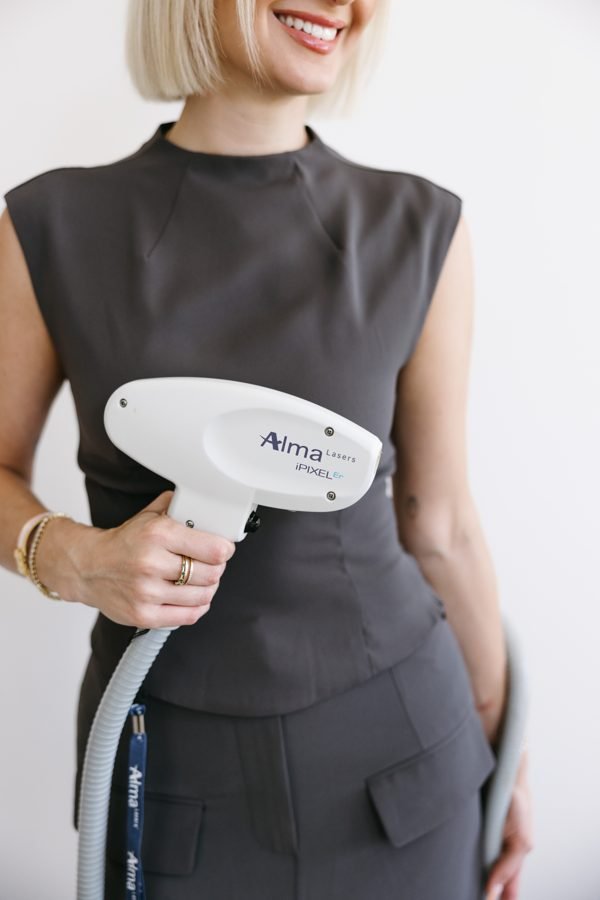
Fractional ablative resurfacing. Privé performs fractional ablative resurfacing on the Alma Harmony XL using its 2940 nm Er:YAG handpiece, known as iPixel. Er:YAG energy is absorbed by water in the tissue, creating columns of controlled ablation with intact skin between them, which is what allows the surrounding tissue to drive rapid repair. It is used for texture, fine lines, and scarring. It also produces several days of visible downtime and leaves resurfaced skin distinctly sun-sensitive for weeks afterward — which is precisely why it belongs in autumn rather than August.
IPL and photofacial for pigment. Our IPL photofacial runs on the Alma Harmony XL AFT platform, treating sun-induced brown spots, diffuse redness, and vascular irregularity. Because it works by targeting pigment and hemoglobin directly, it is the treatment most sensitive to recent tanning — and, not coincidentally, the treatment most in demand after a summer of accumulating sun damage. For patients whose concern is melasma specifically, we approach light-based treatment with real caution; melasma can be aggravated by heat and light, and the plan often looks different.
Medium-depth chemical peels. Jessner's and TCA peels ask for a healing window with disciplined sun avoidance, and the peeling phase itself is not a summer look. Fall is the natural home for them.
Laser hair removal series. Laser hair removal at Privé is performed on the Alma Soprano XL, an 810 nm diode using SHR — a gradual-heating, in-motion technique that is appropriate across the full range of skin types, including deeper phototypes. Even so, treating recently tanned skin is avoided. The stronger argument for fall is arithmetic: a hair removal series typically runs six to eight sessions spaced several weeks apart, because follicles can only be treated in their active growth phase. Starting in September means the series is finished by spring. Starting in April means being mid-series in swimsuit season, with the shaving-only requirement that comes with it.
The runway argument
The seasonal case for fall is about safety. The strategic case is about time.
Collagen does not respond quickly. When a fractional or radiofrequency treatment creates controlled thermal injury, the visible surface change is only the beginning; the dermal remodeling — new collagen synthesis, gradual firming, refinement of texture — unfolds over roughly three to six months. Patients who judge a treatment at three weeks are looking at healing, not at results.
That timeline is the whole argument. A series begun in September has finished its sessions by the New Year and is delivering its full collagen response through February and March. The same series begun in March is still building when the sun returns, and it is being asked to build while UV exposure works against it.
Layered treatments compound this. Most series protocols — three to five photofacial sessions, three or more resurfacing or microneedling sessions — are spaced four to six weeks apart. Multiply that out and a complete course occupies three to five months before the maturation period even begins. Autumn is the only starting point in the Dallas calendar that gives a full course room to finish and settle before the next summer. Individual protocols and timelines are determined at consultation, and results vary.
What we still do year-round
Fall is not a gate. A significant part of the practice is unaffected by the season, and these are what we keep patients on between the heavier work.
DiamondGlow (Allergan) — simultaneous exfoliation, extraction, and infusion of condition-specific serums, with no downtime. Dermaplaning for surface texture and vellus hair. SkinPen (Crown Aesthetics) microneedling, which creates its micro-injuries mechanically rather than with light or heat and is therefore not subject to the same pigment considerations; when a topical is indicated afterward, it is applied to the skin surface after the microneedling pass. Timeless Evolution radiofrequency microneedling, which delivers energy at depth without a melanin-absorbed wavelength — the reason it is often our preferred choice for deeper skin tones and for patients who want meaningful collagen work without the seasonal constraint. Injectables — neuromodulators and dermal fillers — carry no light-based sun consideration at all.
Two devices sit in their own category. AviClear (Cutera), a 1726 nm laser targeting the sebaceous gland for acne, and Clear + Brilliant (Solta), a gentle non-ablative fractional treatment, are both used across the year, though sun-protection guidance still applies around each session. Suitability and timing for any of these is determined at consultation.
How we plan a fall-to-spring calendar
At consultation we are not selling a package. We are mapping a sequence backward from a date.
The conversation starts with what actually bothers you and what the skin will tolerate: concern, Fitzpatrick type, history of hyperpigmentation, current actives, medications with photosensitizing potential, and any prior treatment history. Then the calendar. We ask directly about travel — a week somewhere sunny in December reorders everything, and it is far better to know in September than to discover it two days before a session. We ask about events, because downtime has to land somewhere it does not matter.
From there the sequence usually follows a logic of pigment first, then texture, then maintenance. Surface pigment and redness are addressed early, because clearing them changes what the remaining texture concerns actually look like. Collagen-building work follows, timed so the maturation window lands in late winter. Maintenance treatments fill the intervals. And the plan is written with the assumption that it will be adjusted — if the skin responds faster or slower than expected, the schedule moves. Elizabeth Hurley, RN, BSN, CANS, leads treatment planning, with medical oversight from Medical Director Dr. Gregory Gardner, DO.
The one rule that doesn't change
Sunscreen is not seasonal, and this is where the fall-laser framing gets misread most often.
UVB — the burning wavelength — does fall off substantially in winter. UVA does not, to nearly the same degree. It stays comparatively steady across the year, penetrates deeper into the dermis, passes through window glass, and is the wavelength most implicated in pigment change and photoaging. The Dallas UV index in October still routinely reaches the moderate to high range on clear days. A November commute down the Tollway is real UVA exposure.
So the standard does not move: broad-spectrum SPF 30 or higher, every day, reapplied when you are outdoors for any length of time. After any laser, light, or resurfacing treatment, it is not optional — it is the single behavior that most determines whether the result holds. Everything else we do in the treatment room can be undone by six unprotected weeks. The brown spots we treat are, almost without exception, the record of sun exposure from years the skin was not protected. There is no reason to keep writing that record.
Frequently asked
Why can't I get a laser treatment in the summer?
It is less an absolute prohibition than a risk calculation. Light-based treatments work by delivering energy that is absorbed by pigment in the skin. Recent sun exposure raises the amount of melanin available to absorb that energy, which increases the risk of burns, blistering, and post-inflammatory hyperpigmentation. Freshly treated skin is also more vulnerable to UV, and a single unprotected afternoon outdoors afterward can undo the result. In Dallas, where summer UV is intense and prolonged, the safest course for aggressive resurfacing and pigment-targeting treatments is to schedule them when sun exposure before and after can be genuinely controlled. Candidacy and timing are always determined at consultation.
Is fall really better, or is that just marketing?
The underlying reason is clinical, not promotional. Shorter days, lower sun angle, and cooler temperatures in North Texas mean less incidental UV exposure and easier aftercare — long sleeves, less time outdoors, fewer pool days. That reduces the two main variables that complicate laser and light-based treatment: sun exposure before treatment and sun exposure during healing. The seasonal framing is real, but it is a matter of degree rather than a hard switch. A disciplined patient can be treated in July, and a careless one can have a poor outcome in November.
How long before I see results from a laser series?
It depends on what is being treated. Surface pigment and redness treated with the Alma Harmony XL AFT photofacial often shows visible change within one to three weeks of a session, with a typical series of three to five sessions spaced roughly four weeks apart. Collagen-dependent change from fractional resurfacing or radiofrequency microneedling builds gradually over roughly three to six months as new collagen forms. Laser hair removal is a series, usually six to eight sessions spaced several weeks apart, because hair must be treated in its active growth phase. Results vary by individual, and a realistic timeline is set at consultation.
Can I still get treatments if I'm going somewhere sunny for the holidays?
Yes, with planning. Tell us about the trip at consultation and we build the calendar around it. Generally we prefer to complete more aggressive resurfacing or pigment work with a clear healing window before departure, or schedule it for after you return. Gentler options such as DiamondGlow, dermaplaning, or SkinPen microneedling are usually easier to fit near travel. The specific interval depends on the treatment and your skin, and is determined at consultation.
Do I still need sunscreen in the fall?
Yes. UVA levels in Dallas remain meaningful through autumn and winter, and UVA is the wavelength most associated with pigment change and photoaging. It also passes through window glass, so commuting and desk work near a window still count. We ask patients to wear a broad-spectrum SPF 30 or higher daily, year-round, and to reapply when outdoors. Sunscreen is not an accessory to laser work; it is the thing that protects the investment.
What should I start with?
A consultation, so the sequence is built around your skin rather than a package. In general terms: brown spots and diffuse redness are often addressed first with the Alma Harmony XL AFT photofacial; texture, fine lines, and scarring with fractional resurfacing or Timeless Evolution radiofrequency microneedling; unwanted hair with the Alma Soprano XL diode, which is appropriate across skin types. For deeper or melanin-rich skin tones we generally favor radiofrequency-based and conservative approaches over aggressive light-based treatment. Elizabeth Hurley, RN, BSN, CANS, leads treatment planning; Dr. Gregory Gardner, DO, provides medical oversight as Medical Director. Results vary by individual.