
Every September the same conversation arrives at the front desk in Highland Park: I stopped my retinol in June, I want to start again, and last time I restarted my face peeled for three weeks. The product is rarely the problem. The restart is.
A retinoid is one of the few topicals with decades of evidence behind it for texture, tone, and the visible signs of photoaging. It is also the topical most likely to be abandoned, restarted badly, and abandoned again. In Dallas that cycle runs on a seasonal clock: pause in June, restart in September, over-correct in week two, and quit in October with a barrier that is worse than when you began.
This is the version of the conversation we have in the treatment room, written down. What actually happens to your skin over a Texas summer, why the dose you stopped at is no longer the dose you can start at, how to rebuild tolerance without a peeling face, and how to tell the difference between skin adjusting and skin in trouble. Individual routines are always selected at consultation — nothing here is a prescription.
Why so many people stop in summer — and restart in fall
The summer pause is usually rational. Retinoids can increase sun sensitivity, and North Texas summers deliver the two conditions that make that sensitivity expensive: sustained high UV and relentless heat. From June through August, most of our patients are outside more, sweating more, and reapplying sunscreen less consistently than they believe they are. Add pool chlorine, salt water, and a long weekend at the lake, and the risk of pigment change on retinoid-thinned, freshly exfoliated skin goes up meaningfully.
Heat contributes on its own. Occlusion from sweat, humidity, and the constant swing between 100-degree parking lots and aggressive air conditioning all destabilize the barrier before any active touches the face. A product that felt unremarkable in February can sting in July for reasons that have nothing to do with the formula.
So people stop, sensibly. Then Labor Day passes, the light softens, the sleeves come back, and there is a wedding or a holiday season on the calendar. The motivation to restart is at its annual peak — which is exactly what makes the next mistake so common.
The mistake — restarting where you left off
Nearly everyone restarts at the frequency and product strength they stopped at. If you were using a retinoid five nights a week in May, you pick up the same tube in September and go straight back to five nights a week. It feels logical. It is the single most reliable way to end up flaking by the following weekend.
Tolerance to retinoids is not permanent. It is a state your skin maintains through consistent exposure, and it fades when the exposure stops. After eight to twelve weeks off, the skin's capacity to absorb a retinoid without visible irritation has meaningfully regressed. Your skin does not remember May. It only knows what you have given it recently, which is nothing.
The second half of the mistake is compensation. Having lost a summer, patients reach for more — a higher strength, a nightly cadence, sometimes a retinoid layered with an acid or a scrub in the same routine. The result is a barrier under simultaneous assault, and the visible outcome is not renewal. It is redness, tightness, and the peeling that gets described to us as a bad reaction to the product.
How to rebuild tolerance — slowly, on purpose
The reintroduction we most often walk patients through starts at two nights a week. Not four, not alternate nights. Two.
Apply to skin that is completely dry — damp skin drives penetration up and irritation with it, so give it a few minutes after cleansing. Use a small amount, roughly a pea for the full face, and keep it away from the corners of the nose, the corners of the mouth, and the immediate eyelid margin, which are where the flaking usually starts. Then buffer: a layer of a bland, barrier-supporting moisturizer applied before the retinoid, after it, or both, depending on how reactive your skin runs. Buffering does not neutralize the active. It moderates the ramp.
Hold that cadence for two to three weeks. If the skin is comfortable — no persistent stinging, no tightness the following morning, no rough patches — move to three nights. Hold again. Then alternate nights. Some patients arrive at nightly use by December; others stay at three or four nights indefinitely and get an excellent result there. Nightly use is not the goal. Consistent, sustainable use is.
This is where the honest sentence belongs: more is not faster. Retinoid results are driven by cumulative months of consistent exposure, not by intensity in any given week. A patient who uses a moderate product three nights a week for a year will almost always be ahead of a patient who pushed too hard in October, wrecked their barrier, and spent November recovering. Results vary, and the pace that suits your skin is decided with your provider at consultation.
Purging versus irritation — how to tell
Purging is real, and it is over-diagnosed. Patients use it to justify weeks of discomfort that were never purging at all.
Purging is accelerated turnover bringing existing congestion to the surface sooner than it would have arrived on its own. It appears where you already break out — your usual chin, your usual jawline. It looks like the breakouts you recognize, arriving faster. It typically shows in the first two to six weeks and resolves as the skin adapts.
Irritation is different in character and in location. It appears anywhere, including zones that never break out. It reads as stinging on application, burning, tightness, visible redness, sheet-like or rough flaking, and a new sensitivity to products that never bothered you — your usual cleanser suddenly hurts. That last one is the most useful tell we know.
Purging is worth riding out, ideally at a reduced frequency. Irritation is a stop signal. Stop when you see open or weeping skin, a rash-like eruption, swelling, or discomfort that does not settle within a day of skipping an application. Pause the retinoid entirely, simplify to cleanser, moisturizer, and sunscreen, and let the skin recover before returning at a lower frequency. When you cannot tell which one you are looking at, send us a photo or come in — that assessment takes five minutes.
The barrier comes first
Everything above rests on one principle we apply across the practice: no active earns priority over an intact barrier.
A compromised barrier announces itself. Stinging when you apply products that used to feel neutral. A tight, drawn feeling after cleansing that does not resolve until you moisturize. Flaking that is rough rather than fine. Persistent redness. New reactivity, new sensitivity, skin that feels raw under makeup. Sometimes, counterintuitively, more oil and more congestion, as dehydrated skin overcompensates.
The repair is unglamorous and it works. Pull the actives — all of them, not just the retinoid. Cleanse gently once a day rather than twice. Moisturize generously with something bland and occlusive enough to hold water in. Sunscreen daily. Give it one to two weeks. Do not exfoliate, do not add a new product to fix the problem, and do not book a resurfacing treatment while the barrier is down. Then reintroduce the retinoid at a lower frequency than the one that caused the trouble. Patients who do this in September are usually further along by January than patients who pushed through.
What we carry — and why
Privé stocks four provider-dispensed lines. We chose them by concern, not by claim, and we deliberately do not carry twenty brands.
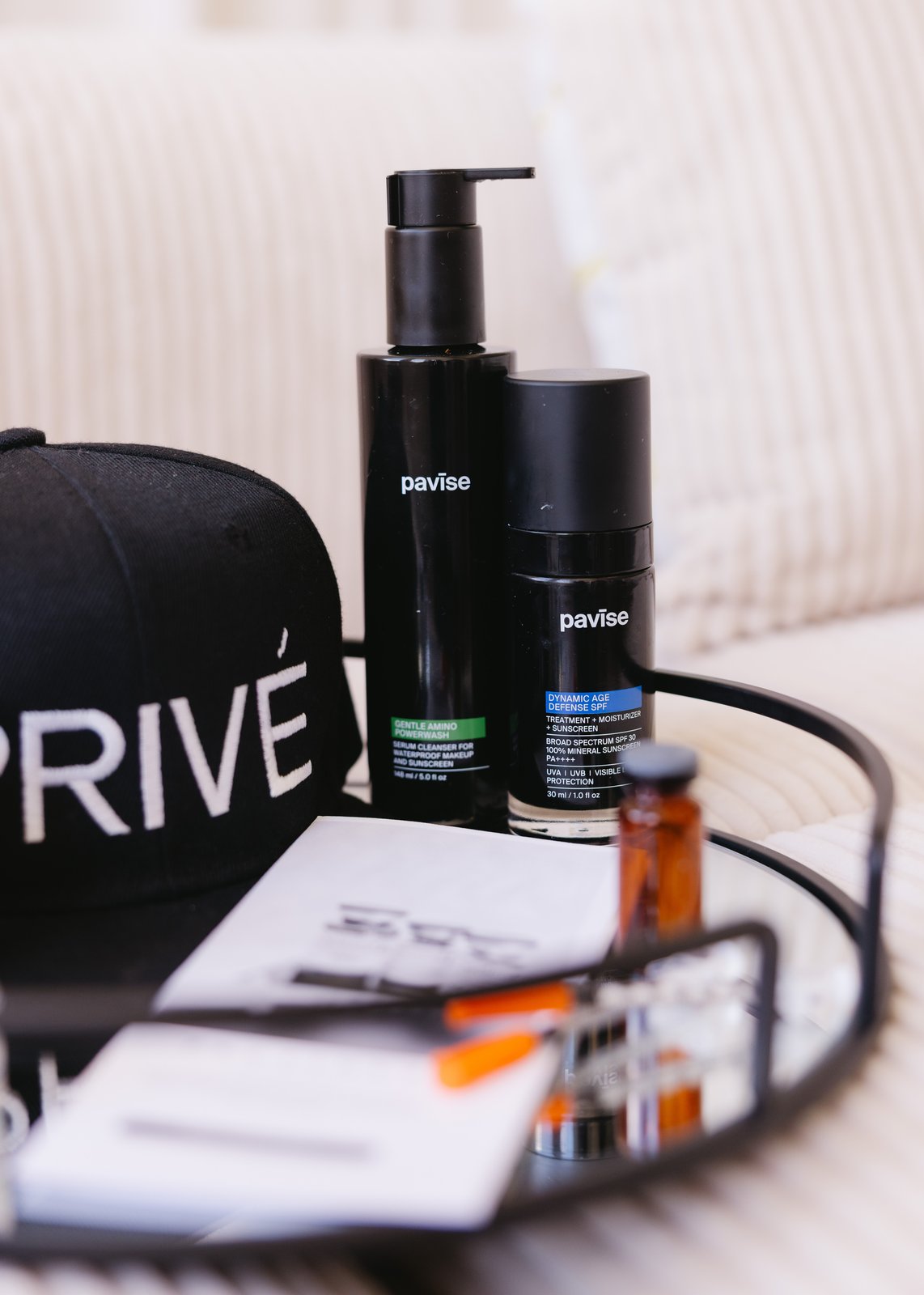
skinbetter science is our workhorse for tone, texture, and the visible signs of photoaging. Its AlphaRet technology pairs a retinoid with an alpha hydroxy acid in a single formulation designed to be better tolerated than the two used separately — which makes it a frequent choice for a fall restart in patients who found straight retinoid use difficult. Marini SkinSolutions, formerly Jan Marini, is where we go for congestion-prone and acne-prone skin that still needs anti-aging support, and for patients who want a structured, staged system rather than individual products. Hydrinity is our hydration and calming line, built around advanced hyaluronic acid technology — it is what we reach for during barrier repair, after in-office treatments, and for patients whose primary complaint is dehydration or reactivity. Pavise is our photoprotection and pigment-support line, formulated around next-generation UV filtration for patients whose main concern is sun-driven discoloration.
Some of these are available at provider-tier strengths that are not sold over the counter, which is precisely why they are dispensed rather than shelved. Selection, sequencing, and how they combine with anything you already own is decided at consultation and reviewed as your skin changes. You can see the current lineup on our shop page, and we are happy to build the routine in person.
Retinoids and in-office treatments
A fall restart usually overlaps with treatment season, which is where the sequencing matters most. Retinoids are held for a defined window before chemical peels, before fractional resurfacing on our Alma Harmony XL 2940 nm Er:YAG, before microneedling with the SkinPen by Crown Aesthetics and radiofrequency microneedling on the Timeless Evolution, and before dermaplaning and DiamondGlow by Allergan. Skin that has been on a retinoid is more reactive to controlled injury, and the point of the hold is to keep the treatment predictable.
The specific hold and resume windows are set per protocol by your provider — they differ by treatment, by product, and by how your skin has behaved historically. We give you those dates at booking so the decision is not made from memory at 10 p.m. the night before. Resumption is always gated on the skin looking and feeling recovered, not on the calendar alone.
One clarification patients ask about: after microneedling we apply Ariessence topically, as a post-procedure topical serum. It is applied to the skin, not injected. If you are planning a season of skin rejuvenation work, tell us at the first appointment and we will build the retinoid schedule around the treatment calendar rather than in conflict with it. For medically appropriate candidates; results vary.
SPF is the non-negotiable partner
There is no version of this routine that works without daily broad-spectrum sunscreen, and Dallas makes that non-negotiable rather than seasonal. UVA levels in North Texas stay meaningful through the fall and winter, they pass through window glass, and they are indifferent to the temperature outside. The exposure that drives most cumulative photoaging is not the beach day — it is the commute, the school pickup, the patio lunch, five days a week, for years.
Because retinoid use can increase sun sensitivity, restarting one without committing to daily SPF is working against yourself: you are accelerating turnover on skin you are leaving unprotected, and pigment is the usual consequence. We carry mineral and mineral-forward broad-spectrum options from the lines above, including Pavise for patients whose primary concern is discoloration. The best sunscreen remains the one you will actually reapply, which is a texture and finish conversation as much as a formulation one — and one worth having in person. See our related notes on chemical peels in Dallas and on DiamondGlow and dermaplane facials if peels or facials are part of your fall plan.
Frequently asked
When should I restart retinol after taking the summer off?
Most patients in Dallas restart comfortably once the daily pattern of heat and sweat breaks — often late September into October. There is no calendar date that applies to everyone. The better signal is behavioral: when you are no longer sweating through the day, no longer spending long stretches outdoors, and your skin feels calm rather than reactive, you are ready to reintroduce. If you are planning a peel, a resurfacing session, or microneedling in the near term, we sequence the restart around that appointment rather than against it. Timing is discussed at consultation.
How often should I use retinol at first?
A slow reintroduction is the standard approach: two nights a week to begin, applied to dry skin, often buffered with a layer of moisturizer before or after. If the skin stays comfortable for two to three weeks, frequency moves up gradually — three nights, then alternate nights, and eventually nightly if your skin tolerates it and your provider agrees. More product applied more often does not accelerate the result; it usually produces irritation that forces a longer pause. Specific products, strengths, and frequency are selected for you at consultation.
Is my skin purging or is it irritated?
Purging tends to show up where you already break out, appears within the first two to six weeks, looks like congestion surfacing faster than usual, and settles on its own as the skin adjusts. Irritation shows up anywhere — including areas that never break out — and reads as stinging, burning, tightness, redness, rough flaking, or new sensitivity to products that never bothered you before. Purging is worth riding out at a reduced frequency. Irritation is a signal to stop, repair the barrier, and restart more slowly. If you are unsure which one you are looking at, send us a photo or come in.
Do I need to stop retinol before a facial or a peel?
Yes, in most cases. Retinoids are typically held for a defined window before chemical peels, fractional resurfacing, microneedling, and dermaplaning, and resumed afterward once the skin has recovered. The exact hold and restart windows are set per protocol by your provider based on the treatment, your skin, and the product you are using — we give you those dates in writing at booking. Do not guess, and do not apply a retinoid the night before a treatment because you forgot and want to catch up.
Is drugstore retinol the same as what you carry?
Not always. Provider-dispensed lines differ in formulation quality, delivery system, stability, and in some cases concentration — several of the products we carry are available at provider-tier strengths that are not sold over the counter. Just as important is the fit: a well-chosen over-the-counter retinol used correctly will outperform a provider-tier product used incorrectly. What you gain by buying through the studio is the selection conversation and the follow-up. Privé carries skinbetter science, Marini SkinSolutions, Hydrinity, and Pavise. Results vary.
Do I really need SPF in the fall in Dallas?
Yes. UVA levels in North Texas remain meaningful year-round, and daily incidental exposure — the commute, the school pickup, the patio lunch — is what drives most cumulative photoaging and pigment change. Retinoid use can increase sun sensitivity, which makes daily broad-spectrum SPF the non-negotiable partner to the routine rather than an optional add-on. We carry mineral and mineral-forward broad-spectrum options from the lines we stock and will help you choose one you will actually reapply.