"Recombinant growth factor" sounds like marketing jargon. It is also — when applied through the right protocol — one of the most interesting developments in regenerative aesthetics in the last decade. This piece walks through what PDGF actually is, what Ariessence specifically is, how it differs from PRP and PRF, and why the delivery method matters more than the molecule itself.
Part of our complete guide to regenerative aesthetics.
The promise without the marketing: a clinical-grade, standardized version of the most active signaling molecule the body uses to repair skin. The catch: it only works when it can reach the cells that need to receive its signal. That is the whole story, and the rest is detail.
What PDGF stands for, and what it does
PDGF is short for platelet-derived growth factor. It is a signaling protein the body releases at sites of injury to recruit fibroblasts — the cells that build new collagen and reorganize the dermis during healing. When you cut yourself, PDGF is one of the first chemical messengers your platelets dump into the wound. Its job is to tell the surrounding cells, in effect, start building.
It is not a niche molecule. PDGF has a substantial track record in mainstream medicine. The FDA has approved four PDGF-containing products — GEM 21S® and Augment® (periodontal and bone regeneration), Augment® Injectable, and Regranex® (for diabetic foot ulcers). None of these are cosmetic. They demonstrate that PDGF as a biologic has clinical credibility in healing contexts.
Aesthetics has been interested in PDGF for years through PRP and PRF therapies, both of which deliver your own platelet-derived growth factors back into the skin. The premise is the same. The difference, with Ariessence, is the delivery mechanism and the source.
What Ariessence Pure PDGF+ specifically is
Ariessence Pure PDGF+ is a recombinant formulation — meaning the PDGF molecule has been bioengineered in a controlled manufacturing setting rather than harvested from human blood. It arrives in a sterile vial at a standardized concentration and clinical-grade purity. The manufacturer is LRM Aesthetics. The product is filed with the FDA as a cosmetic product, intended for topical use post-procedure.
The benefit of the recombinant form, compared with what your platelets give you, is consistency. Every vial contains the same dose of PDGF, regardless of how hydrated you are that morning, how recently you exercised, or any of the dozens of variables that affect the natural concentration of platelets in any given blood draw. From a clinical standpoint, that predictability matters — it makes outcomes more reproducible across visits and across patients.
How it differs from PRP and PRF
The honest comparison: both PRP/PRF and Ariessence work on the same principle — growth factor signaling that recruits fibroblasts and stimulates collagen remodeling. The practical differences shape which one fits a given patient.
PRP and PRF are autologous. The growth factors come from your own blood, processed in-office via centrifuge. There is a blood draw at the start of every appointment, and the resulting concentrate is used immediately. The molecule profile is broader than just PDGF — you also get VEGF, TGF-β, IGF-1, and a host of other signaling proteins your platelets carry. The trade-off is variability: what your platelets contain on any given day depends on you.
Ariessence is manufactured and standardized. No blood draw, no centrifuge. The vial is opened and applied. The growth factor profile is narrower — this is recombinant PDGF specifically — but the concentration is reliable. For patients with needle-shy preferences or those who want a more predictable result session over session, this is the operational advantage.
In practice, the two are not mutually exclusive. Some clients pair them, alternating sessions or stacking them depending on goals. The right answer is consultation territory — it depends on your skin, your timeline, and what you're trying to address.
The delivery problem — and the topical-with-microchannels solution
Here is the part most marketing copy skips. Skin's outermost layer — the stratum corneum — is a barrier specifically designed to prevent large molecules from crossing into the body. Apply a growth factor to intact skin and most of it sits on the surface, then washes away. The fibroblasts that need to receive the signal are several microns below, in the upper dermis, behind a wall that does its job extremely well.
This is why we pair Ariessence with a procedure that creates microchannels — most often SkinPen microneedling, but also RF microneedling, fractional laser, or a medium-depth chemical peel. Each of these creates thousands of tiny vertical channels that bypass the stratum corneum and reach the upper dermis. While those channels are still fresh, Ariessence is applied topically. The growth factor reaches the cells that can use it.
The strongest published evidence for this protocol is the Gold 2025 randomized controlled trial, which paired recombinant PDGF with Morpheus8 radiofrequency microneedling. At 30 days post-treatment, the PDGF arm showed statistically significant improvement in skin quality versus a bland emollient control. The mechanism is the same whether the microchannels come from Morpheus8, SkinPen, or fractional laser: open the channels, deliver the signal, let the fibroblasts respond. That is the protocol that has clinical evidence behind it, and it is the protocol we built our signature regenerative pathway around.
What it's used for
The list of indications, in our practice, runs in roughly this order:
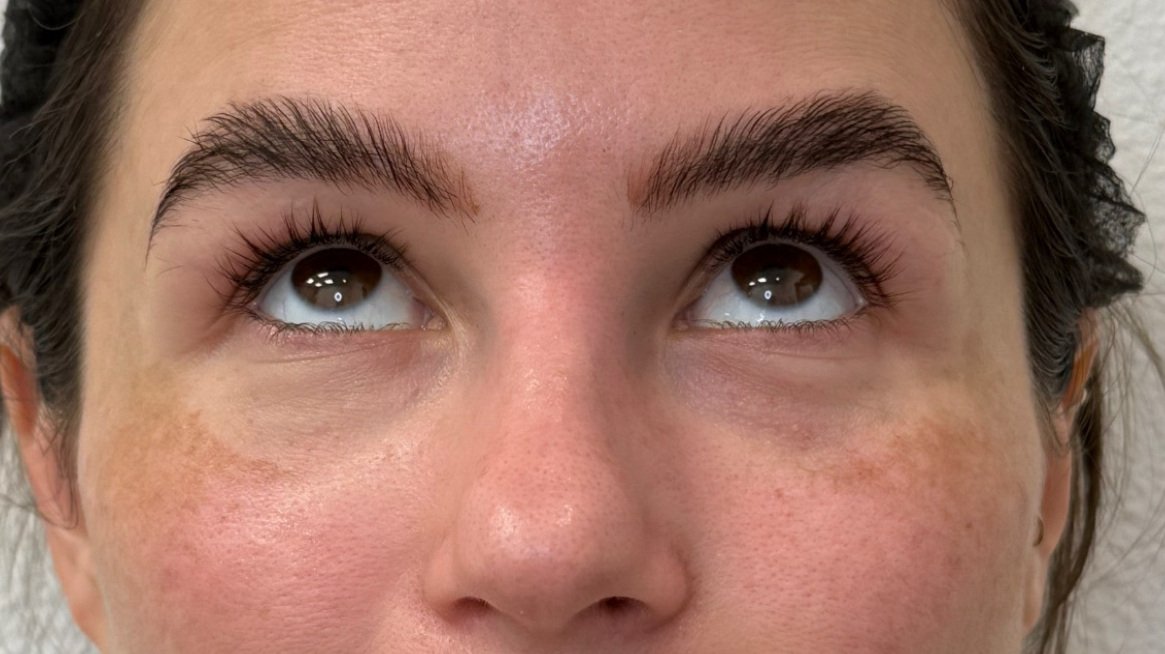
- Under-eye texture, crepiness, and tone (one of the most common reasons clients ask about it)
- Mid-face skin quality — smoothness, fine lines, and texture refinement
- Neck and décolleté skin remodeling
- Hand rejuvenation
- Post-procedure recovery support after laser or peel sessions
What it does not replace is volume restoration. If the underlying issue is hollowing — whether under the eye, in the temples, or in the mid-face — a regenerative protocol is not the answer; filler, Sculptra, or biostimulator work is. We try to be clear about this distinction in consultation. Texture and volume are different problems with different solutions.
What to expect — timeline and cadence
A typical appointment runs 60 to 90 minutes, depending on the channel-creating procedure chosen. Topical numbing first; then the procedure (SkinPen, RF, laser, or peel); then Ariessence application across the treatment area. The vial is typically used in a single session.
Post-treatment, expect light redness for 24 to 48 hours — the same downtime as the underlying procedure. Skin should not be exposed to sun, makeup, or active skincare for roughly 24 hours. Tone clarification usually shows in 2 to 4 weeks; texture refinement and the deeper collagen remodeling response keeps building through 8 to 12 weeks.
For most clients, the initial protocol is a series of 2 to 3 sessions spaced 4 to 6 weeks apart, followed by maintenance every 6 to 9 months. The cadence depends on how skin responds and what the broader treatment plan looks like. For clients pursuing a more comprehensive regenerative pathway, Ariessence sometimes pairs with EZGel — one autologous biostimulator, one recombinant growth factor — covering both sides of the regenerative conversation.
Who it's for, who it isn't
Ideal candidates are clients with texture and tone concerns who want a clinically grounded regenerative approach, without the volume changes that come from filler or the longer timeline that comes from biostimulator-only protocols. The conversation is often: my skin doesn't feel like mine anymore, but I don't want my face to look different. That is the brief Ariessence answers well.
It is not the right answer if the underlying concern is volume loss, if there is active skin infection at the proposed treatment site, or during pregnancy or breastfeeding. As with all regenerative protocols at Privé, the decision sits inside a consultation with full medical history review. Procedures are MD-supervised by Medical Director Dr. Gregory Gardner, DO.
The summary
- PDGF is a growth factor the body uses to recruit fibroblasts during healing. It has FDA-approved medical uses (not cosmetic) that establish its clinical track record.
- Ariessence Pure PDGF+ is the recombinant version — bioengineered, standardized, FDA-classified as a cosmetic product intended for topical use.
- It differs from PRP and PRF by being manufactured rather than autologous, with predictable dose and no blood draw.
- Delivery is everything. Without microchannels, topical growth factor cannot reach the dermis. SkinPen, RF microneedling, fractional laser, and medium peels create those channels.
- Best for texture, tone, and skin-quality concerns — not for volume restoration.
- Cadence: 2-3 sessions 4-6 weeks apart, maintenance every 6-9 months.
If you've been considering microneedling, or have been told you should be doing something about under-eye texture, or are weighing the difference between PRP and a recombinant approach — this is the conversation we'd rather have in person than in writing. Book a consultation and we'll map it together.