Privé's regenerative work is the category we are best known for — topical Ariessence Pure PDGF after microneedling, plus PRP, PRF and EZGel made from your own blood. This guide covers what each one actually is, how we choose between them, the honest timelines, what they will not do, what they cost, and a direct answer to the question we get more than any other: whether Ariessence is an injection.
What regenerative aesthetics actually means
It is a category name for treatments that don't add a material to the face so much as ask the face to rebuild itself. Filler adds volume on the day. Regenerative treatment creates a controlled signal — a growth factor, a micro-injury, a fibrin scaffold — and the result is whatever your own biology makes of it over the following months.
That difference sets the expectations for everything below. These treatments are slower than filler, they are less predictable in timing, and what they produce is your own tissue rather than a product. In exchange, the result tends to hold far longer than the material that triggered it, and it improves skin quality rather than just position.
Privé works in four of these: topical Ariessence Pure PDGF, PRP, PRF, and EZGel. They are not interchangeable.
Ariessence Pure PDGF — topical, at Privé
PDGF is platelet-derived growth factor: a signalling protein your platelets release when tissue is damaged. It tells cells to come to the site, multiply, and build new matrix. It is one of the earliest and most important signals in normal healing.
Ariessence uses a recombinant PDGF — manufactured rather than spun out of your blood. That matters for one practical reason: the concentration is identical every single time. With PRP, the yield depends on the patient, the draw, the spin and the day. With recombinant PDGF it does not vary.
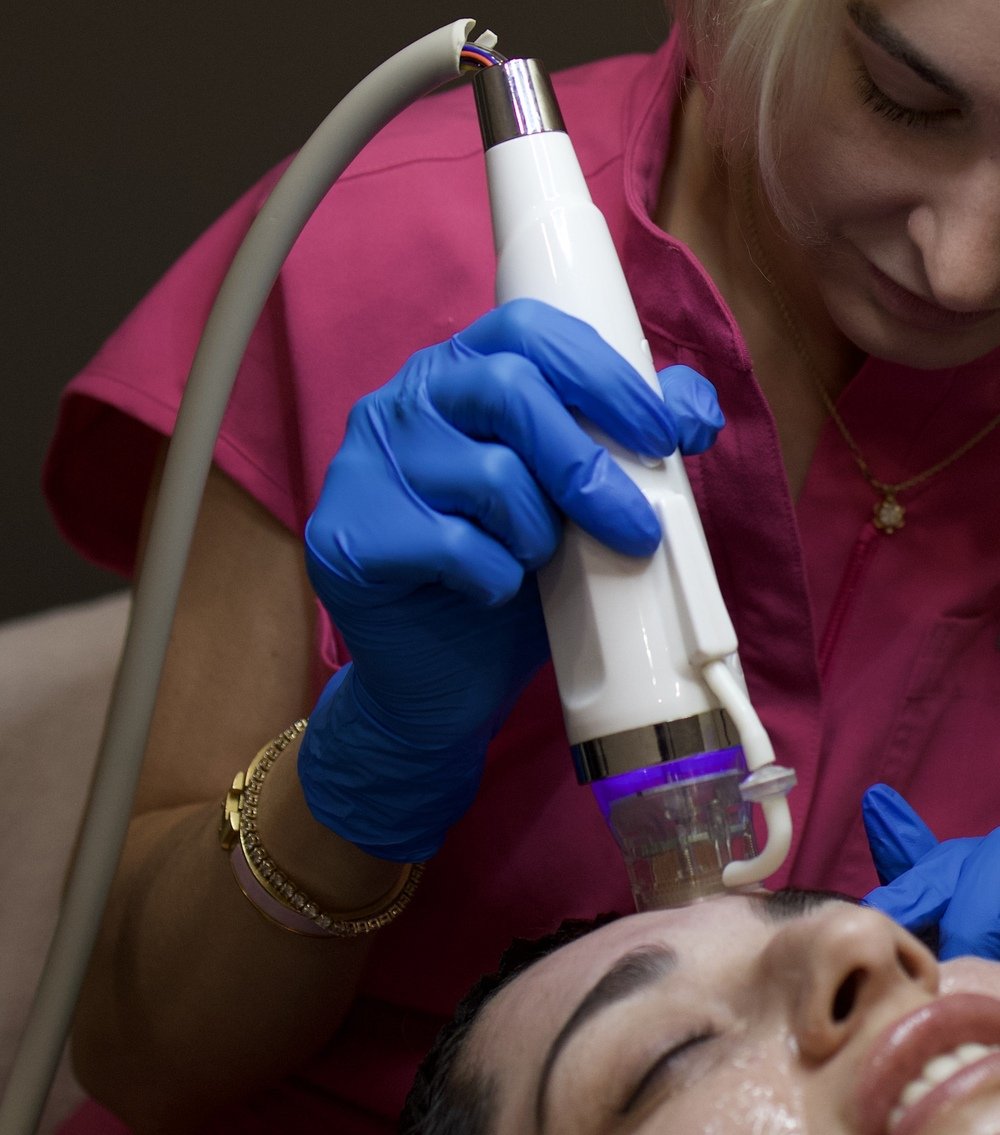
At Privé, Ariessence is applied topically, immediately after microneedling, while the channels the needles created are still open. That is the protocol we perform and the only one we publish.
Is Ariessence an injection?
It is the most-asked question about it, and the honest answer is: not in our standard public-facing protocol. What we publish, price and describe is the topical one — Ariessence Pure PDGF applied immediately after microneedling, while the channels the needles created are still open.
You will see some clinics in Dallas and beyond describe PDGF as an injection. Part of that is a genuine difference in practice, and part is language blurring: a SkinPen session involves a needling device even when nothing is being injected through a syringe.
If you have read about other approaches and want to know what would actually be appropriate for you, that is a conversation we have in person, at consultation, under our Medical Director — not something we price on a menu or describe in advance. We have written about the distinction in full here.
PRP, PRF and the difference people miss
Both are made from a vial of your own blood, spun in a centrifuge. The difference is how.
PRP — platelet-rich plasma — is spun fast, with an anticoagulant. You get a liquid concentrate of platelets, and the growth factors release over hours.
PRF — platelet-rich fibrin — is spun slower and with no anticoagulant, so the blood is allowed to begin clotting naturally. A fibrin scaffold forms, trapping platelets and white cells inside it, and the growth factors release gradually over days rather than hours. It also contains cell populations PRP largely discards.
PRF is the newer approach and the one we reach for more often. Both are injected — unlike the topical PDGF protocol above — and both are genuinely autologous: nothing is added that did not come out of your arm.
EZGel — your own blood, as a gel
EZGel takes PRF a step further. Part of the plasma is heated and then cooled, which changes the protein structure into a gel, and that gel is recombined with the liquid fraction. The result behaves like a soft, biostimulating filler made entirely from you.
We use it where a small amount of structure plus a biological signal is wanted at once: under-eye hollowing, fine lines, acne scarring, general texture. It starts at $1,000. There is a full piece on it if you want the detail.
How we choose between them
The honest version: it depends on whether your problem is a surface or a place.
- Skin quality across an area — tone, texture, pores, early crepiness. Microneedling with topical Ariessence PDGF.
- A specific hollow or depression — under-eye, a scar, a defined area wanting structure. PRF or EZGel, placed.
- Hair — PRP and PRF both have a role in hair restoration, and it is a series, not a visit.
- Volume across the mid-face — this is usually not a regenerative question at all. It is filler or Sculptra, and we will say so.
Many people end up doing more than one across a year, in sequence rather than at once. We have written a direct comparison of all three.
The signature protocol: SkinPen + Ariessence
This is the combination Privé is known for. SkinPen microneedling creates the controlled micro-injury and the open channels; topical Ariessence Pure PDGF is applied into them immediately afterward, while they are still receptive.
The logic is that microneedling alone already triggers a healing response — adding a consistent, high-concentration growth-factor signal at the exact moment the skin is primed for it compounds the result rather than replacing it. Three sessions, four to six weeks apart, is the usual starting series. The full protocol is written up here.
Timelines, honestly
Nothing here is fast. Collagen formation and remodelling take months, and no protocol shortcuts that.
- Weeks 1–2: surface glow from the microneedling itself. This is not the result.
- Weeks 6–8: the first genuine change in texture and tone.
- Months 3–4: the real result, and the point at which to judge it.
- Beyond: continued development, then maintenance once or twice a year.
If you need to look different in a fortnight, this is the wrong category and we will tell you so.
What it won’t do
Regenerative treatment improves skin quality and stimulates tissue. It does not lift significantly loose skin, it does not replace meaningful volume loss, and it does not resolve deep static folds. Those are different problems with different answers, and a regenerative series sold as the solution to them will disappoint.
It is also not a one-visit category. Anyone offering a single appointment with a dramatic before-and-after is describing something other than what the biology does.
What it costs
- Microneedling with Ariessence Pure PDGF — $525
- PDGF upgrade on any skin service — $300
- EZGel — from $1,000
- EZ PRF — from $599
- SkinPen microneedling — from $225, or +$300 with Ariessence PDGF
All of it is published on our pricing page rather than quoted on request.
Who performs it
Elizabeth Hurley, RN, BSN, CANS — a Certified Aesthetic Nurse Specialist — with medical oversight by Medical Director Dr. Gregory Gardner, DO. Blood-derived treatments are drawn, processed and administered in studio.
Frequently asked
Is Ariessence Pure PDGF an injection?
Not in our standard public-facing protocol. What Privé publishes and prices is the topical one: Ariessence Pure PDGF applied immediately after microneedling, while the channels the needles created are still open. Anything beyond that is a clinical decision made in person, in consultation, under our Medical Director — not something we describe or price in advance.
What is PDGF?
Platelet-derived growth factor, a signalling protein your own platelets release during healing. It tells cells to migrate to the site, proliferate and lay down new matrix. Ariessence uses a recombinant form — manufactured rather than drawn from your blood — which means consistent concentration every time, unlike PRP where the yield varies with the patient and the draw.
What is the difference between PRP and PRF?
Both are made from your own blood. PRP (platelet-rich plasma) is spun at higher speed with an anticoagulant, producing a liquid concentrate released quickly. PRF (platelet-rich fibrin) is spun slower with no anticoagulant, so a fibrin scaffold forms and the growth factors release gradually over days rather than hours. PRF is the newer approach and the one we reach for more often.
What is EZGel?
EZGel is PRF processed a step further — heated and cooled so the plasma forms a gel. It is fully autologous, made from your own blood with no additives, and behaves like a soft biostimulating filler. We use it for under-eye hollowing, fine lines, acne scars and texture. It starts at $1,000.
PDGF vs PRF — which is better?
They answer different questions. Topical PDGF after microneedling is about skin quality across a whole area — tone, texture, the surface. PRF is injected into a specific place to rebuild volume or stimulate in a defined spot. Someone wanting overall skin improvement is usually a PDGF candidate; someone with a hollow under-eye is usually a PRF or EZGel one. Many people end up doing both over a year.
How long does PRF last?
The product itself is absorbed over weeks, but that is not the point of it — the collagen and tissue response it triggers continues developing for months and holds far longer than the material. Most people are looking at a year or more from a completed series, with maintenance after that. It is not filler and it does not behave like filler.
Is the 'vampire facial' the same thing?
That is a marketing name for microneedling with PRP applied. It is a real treatment and it sits in the same family as what we do — we simply do not use the name, and our signature version uses topical Ariessence PDGF rather than PRP because the growth-factor concentration is consistent rather than variable.
How many sessions do I need?
Three is the usual starting series for microneedling with topical PDGF, spaced four to six weeks apart, then maintenance once or twice a year. EZGel and PRF are typically two to three sessions depending on the area. We will give you the number and the spacing in writing before you commit to the first one.
When will I see results?
Not quickly, and anyone promising otherwise is selling something. Collagen takes time to form and remodel. Expect the first visible change around six to eight weeks and the real result at three to four months, continuing to develop after that. This is the opposite trade to filler: slower to arrive, longer to hold.
What does regenerative treatment cost at Privé?
Microneedling with Ariessence Pure PDGF is $525, and the PDGF upgrade is $300 on any skin service. EZGel starts at $1,000. EZ PRF starts at $599. SkinPen microneedling alone starts at $225. Full pricing is published at privemedical.com/pricing.
Who performs regenerative treatment at Privé?
Elizabeth Hurley, RN, BSN, CANS — a Certified Aesthetic Nurse Specialist — with medical oversight by Medical Director Dr. Gregory Gardner, DO. Blood-derived treatments are drawn, processed and administered in studio.
Who should not have these treatments?
Active infection at the site, active inflammatory acne in the treatment area, blood disorders or anticoagulant therapy that makes a blood draw inadvisable, pregnancy, breastfeeding, and recent isotretinoin use. We screen for all of it before anything is drawn or applied, and we will reschedule rather than treat skin that is not ready.
When regenerative isn’t the answer
If your skin barrier is compromised, the answer is two weeks of leaving it alone first. If you have active inflammatory acne in the area, we treat that before anything else. If you are on anticoagulants or have a blood disorder that makes a draw inadvisable, the blood-derived options are off the table and we work with the topical ones. If what you actually want is volume, we will point you at filler or Sculptra and not sell you a series that cannot deliver it.