

September is the month our consultation room fills with people asking the same question — why is my skin worse now than it was in June? The answer is rarely mysterious. A Dallas summer is a months-long stress test on oil production, on the sunscreen and makeup you layer over it, and on the barrier underneath. What surfaces in early autumn is the accumulated bill.
Post-summer breakouts have a particular character. They are congestive rather than dramatic — clogged pores along the jaw and hairline, small inflamed papules across the cheeks, a general dullness and unevenness that was not there in spring. Alongside them sit the marks left by whatever broke out in July and August. Patients usually arrive having already tried something: a stronger cleanser, a stripped-back routine, or a fortnight of skipping sunscreen entirely. Some of those instincts help. Several of them make it worse.
This is the explanation we give in the room, written down — what heat actually does to skin, why sunscreen is not the culprit, why the marks and the acne are two separate problems, and what the tiered plan looks like at Privé.
Why summer breaks skin out
Sebum production is temperature-sensitive. As ambient temperature rises, the sebaceous glands produce more oil — a measurable, predictable physiological response, and one that a Dallas summer sustains for four or five months rather than a few weeks. Humidity compounds it. Skin that is already producing more oil now also holds moisture at the surface, and that combination changes how everything else behaves on the face.
Layered on top of that is what we ask summer skin to carry. Sweat, sunscreen reapplied through the day, makeup over the top, chlorine, dust, and whatever the wind moves around North Texas in August. That mixture does not simply sit inertly on the surface. It settles into follicles already producing excess oil, and congestion follows — first as closed comedones, then, when a follicle becomes inflamed, as the papules and pustules patients actually notice.
The third factor is the one people underestimate, because it is the thing they did to help. When skin feels greasy, the instinct is to wash more often and to wash harder. More frequent cleansing, hotter water, foaming surfactants, scrubs, and astringent toners strip the lipid barrier that holds moisture in and irritants out. A compromised barrier is more reactive, more inflamed, and frequently produces more oil in response, not less. It is entirely possible to make a mild summer congestion problem into a genuine inflammatory acne problem by autumn through over-cleansing alone.
Sunscreen is not the villain
Somewhere in the last few years, sunscreen acquired a reputation as a cause of breakouts, and every September someone tells us they stopped wearing it to let their skin clear. It is an understandable conclusion and a costly trade.
Formulation is the real variable. A water-resistant, high-occlusion sunscreen engineered to survive a day on the lake is not the correct daily face product for oily, congestion-prone skin. Heavy emollients, thick film-formers, and certain silicone-rich textures can absolutely contribute to congestion when worn daily under makeup in the heat. That is a product problem, not an SPF problem.
What we recommend instead is a lighter daily vehicle: a fluid, gel, or thin lotion, labelled non-comedogenic, ideally a mineral formulation with zinc oxide. Zinc has the additional advantage of being mildly calming on inflamed skin. Keep the heavier water-resistant product for the specific days it is designed for. What we do not recommend, under any circumstances, is going without. Ultraviolet exposure drives the exact post-inflammatory pigment you are about to spend months trying to fade, and it deepens every existing mark on the face. Skipping SPF to treat acne trades a solvable problem for a slower, more stubborn one.
The post-summer pigment problem
This is the part patients most often misunderstand. When a breakout in a Dallas summer resolves, it frequently leaves a flat brown, tan, or reddish mark where the inflamed lesion was. That is post-inflammatory hyperpigmentation — pigment deposited in response to inflammation, then reinforced by sun exposure. It is not a scar. It is not a hole or a depression in the skin. It is a colour problem in an otherwise intact surface, and it fades on its own timeline, which can run many months.
Treating the acne and treating the marks are two different jobs, using different tools, in a deliberate order. Clearing the active acne comes first, for the simple reason that every new inflamed lesion writes a new mark. Correcting pigment on a face that is still actively breaking out is running up a down escalator. Once the acne is quiet, pigment work has something stable to act on — daily SPF, topical brightening agents, and in-office treatment such as chemical peels or other pigment-directed approaches. If pigment rather than acne is your primary concern, our writing on melasma and on sun damage, redness, and brown spots covers that side in more depth.
What actually clears it
Our approach is tiered, and it starts with the least invasive thing that works. Not every post-summer breakout needs a laser. A meaningful share of what we see in September resolves with a corrected home routine and a barrier that has been allowed to recover.
That means a gentle, non-stripping cleanser used twice daily and no more. A short pause on scrubs, acid toners, and anything abrasive while the barrier repairs. A lightweight moisturiser — oily skin still needs one, and dehydrated oily skin behaves worse than hydrated oily skin. A well-chosen daily sunscreen. Then, once the barrier is stable, the reintroduction of a targeted active: a salicylic acid product for congestion, or a retinoid used at a sensible frequency rather than nightly from day one. Give that four to six weeks before judging it.
When home care is not enough — when the congestion is entrenched, when inflammation keeps recurring, when the marks are accumulating faster than they fade — that is the point at which in-office treatment earns its place. It is also the point where a consultation matters, because the right in-office option depends on whether we are treating surface congestion, active inflammation, or the underlying oil production itself.
In-office options at Privé
DiamondGlow with a pore-clarifying serum. DiamondGlow (Allergan) combines mechanical exfoliation, extraction of debris from the follicle, and simultaneous infusion of a serum matched to the concern. Paired with a pore-clarifying formulation, it is our most direct answer to congestion — the closed comedones and blocked follicles that a summer accumulates. There is no downtime, and it is the treatment we most often use as a first in-office step.
Jessner's peels. A Jessner's peel combines salicylic acid, lactic acid, and resorcinol. Salicylic acid is the relevant part for acne: it is lipophilic, meaning it is oil-soluble and travels into the sebum-filled follicle rather than acting only on the skin surface. That is a genuinely different mechanism from a water-soluble acid, and it is why salicylic-based peels remain a staple in acne work. Peels are typically done in a short series, and they address surface congestion and post-inflammatory pigment at the same time.
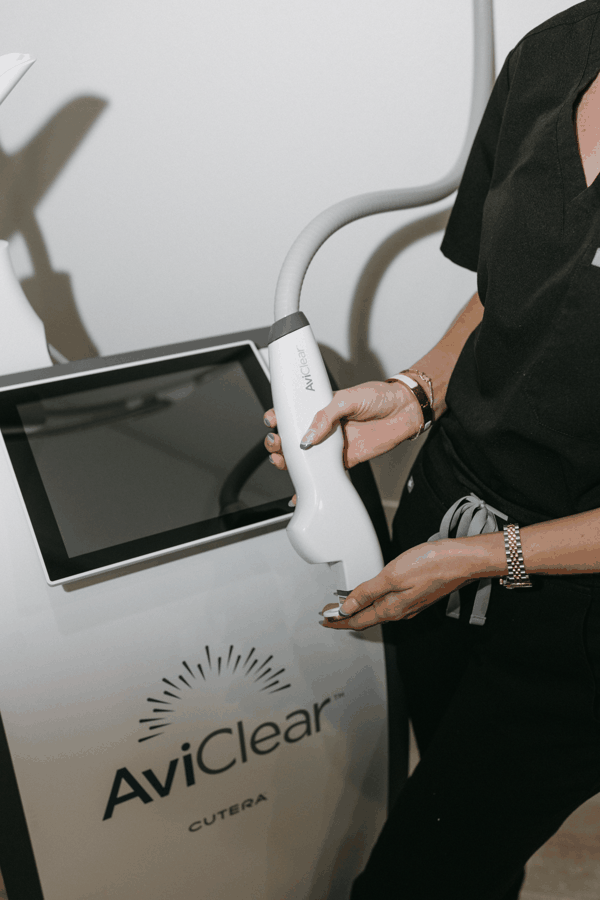
AviClear. AviClear is a Cutera laser operating at 1726 nm, FDA-cleared for the treatment of acne. Its distinction is what it targets. The 1726 nm wavelength is selectively absorbed by sebum, which allows the energy to reach the sebaceous gland itself rather than treating the skin surface or the bacteria on it. It works across all skin types — a meaningful point, because several older acne-directed light treatments were not suitable for deeper skin tones. The standard course is three sessions spaced roughly a month apart, and skin commonly continues to improve for months after the third session, so the picture at the end of the course is not the final picture. Results vary by individual.
The honest note we give every AviClear patient before they book: some people purge before they improve. A temporary increase in breakout activity in the weeks after the first or second session is a known possibility. It generally settles as the course progresses, but it is disconcerting if nobody warned you, so we warn you. AviClear is also a drug-free option, which is why some patients prefer it to a systemic prescription route — that is a preference, not a claim of superiority, and the comparison is worth reading properly in our piece on the two approaches. Everything here is screened and performed under the medical supervision of our Medical Director, Dr. Gregory Gardner, DO. Treatment is not appropriate during pregnancy, over active skin infection, or in combination with certain photosensitising medications.
What we do not do
We do not dermaplane over active pustular lesions. Dermaplaning is an excellent treatment on the right skin — it is not the right treatment on a face with inflamed, pustular acne, where a blade risks spreading bacteria and aggravating lesions that are already compromised. If you come in for dermaplaning and your skin is actively breaking out, we will say so and redirect the appointment.
We also do not perform aggressive resurfacing on inflamed skin. Fractional resurfacing has a genuine role in acne scarring, but running it over active inflammation is the wrong sequence and invites worse pigment afterwards. Restraint here is not caution for its own sake; it is the difference between a face that settles and a face that takes another season to recover.
Fall is the right time to start
There is a practical reason we schedule most acne courses between September and March. Sun exposure drops. That matters twice over: several acne treatments and topicals raise photosensitivity, and ultraviolet exposure darkens exactly the post-inflammatory marks you are trying to clear. A three-session AviClear course begun in September runs through the cooler months and finishes well before the next Texas summer. A peel series follows the same logic.
The other reason is simply that it works with the calendar. Patients who start now are not trying to hide a purge phase under a June wedding or a beach holiday. Starting in autumn gives the process room.
Scarring is a separate conversation
When the acne is under control, some patients find that what is left is not colour but texture — indentations, rolling irregularity, the shallow depressions that follow years of inflammatory lesions. That is scarring, and it is a different workstream entirely.
Texture and scarring are addressed with resurfacing and microneedling — SkinPen (Crown Aesthetics) microneedling, radiofrequency microneedling on the Timeless Evolution, or fractional resurfacing with the Alma Harmony XL 2940 nm Er:YAG, depending on depth and skin type. These are collagen-remodelling treatments. They do not treat acne, and they are not appropriate while acne is active. The sequence is always the same: control the acne, correct the pigment, then address the texture. Attempting the third step before the first is how patients end up disappointed with a treatment that was never wrong — only mistimed. If you want the deeper explanation of the laser itself, what an acne laser actually does is the companion piece to this one.
Frequently asked
Why do I break out more in summer?
Heat and humidity increase sebum production, and a Dallas summer supplies both for months at a time. Sweat mixes with heavier sunscreen, makeup, and environmental debris and sits on the skin, congesting follicles. The common response — washing more often and more aggressively — strips the barrier, which triggers more oil and more inflammation. The breakout you notice in September is usually the accumulated result of all three, not a sudden change in your skin.
Is my sunscreen causing acne?
Sometimes the formulation is contributing, but the answer is almost never to stop wearing sunscreen. Heavy, occlusive, water-resistant sunscreens designed for a pool day are not the right daily face product for oily or acne-prone skin. The fix is a lighter texture — a fluid, gel, or mineral formulation with zinc oxide, labelled non-comedogenic — worn every day. Skipping SPF trades a manageable congestion problem for sun damage and darker post-inflammatory pigment.
How do I get rid of the dark marks left behind?
Those flat brown or reddish marks are post-inflammatory hyperpigmentation, not scars, and they are a separate job from the acne itself. Treating pigment involves daily SPF, topical brightening agents, and in-office work such as chemical peels or other pigment-directed treatments. Clearing the active acne first matters, because every new inflamed lesion creates a new mark. At Privé we usually sequence acne control first, pigment correction second.
How does AviClear work?
AviClear is a Cutera 1726 nm laser that is FDA-cleared for the treatment of acne. The 1726 nm wavelength is selectively absorbed by sebum, allowing the laser to target the sebaceous gland itself rather than the surface of the skin. It is a drug-free, in-office option that works across all skin types. The standard course is three sessions spaced about a month apart, and skin often continues to improve for months after the final session. Results vary by individual.
Will I purge before it gets better?
Some patients do. A temporary period of increased breakout activity in the weeks after the first or second AviClear session is a known and expected possibility, and we tell patients about it before they book rather than after. It typically settles as the course progresses. Response varies from person to person, and part of the reason the course is structured across three sessions with check-ins between them is so we can see how your skin is actually behaving.
When should I start?
Fall is the most practical time to begin an acne course in Dallas. Sun exposure drops, which matters because several acne treatments and topicals increase photosensitivity, and because sun exposure darkens the post-inflammatory marks you are trying to fade. A three-session AviClear course started in September runs through the cooler months. Treatment is not appropriate during pregnancy, over active skin infection, or alongside certain photosensitising medications; we screen for all of this at consultation under the supervision of our Medical Director, Dr. Gregory Gardner, DO.