

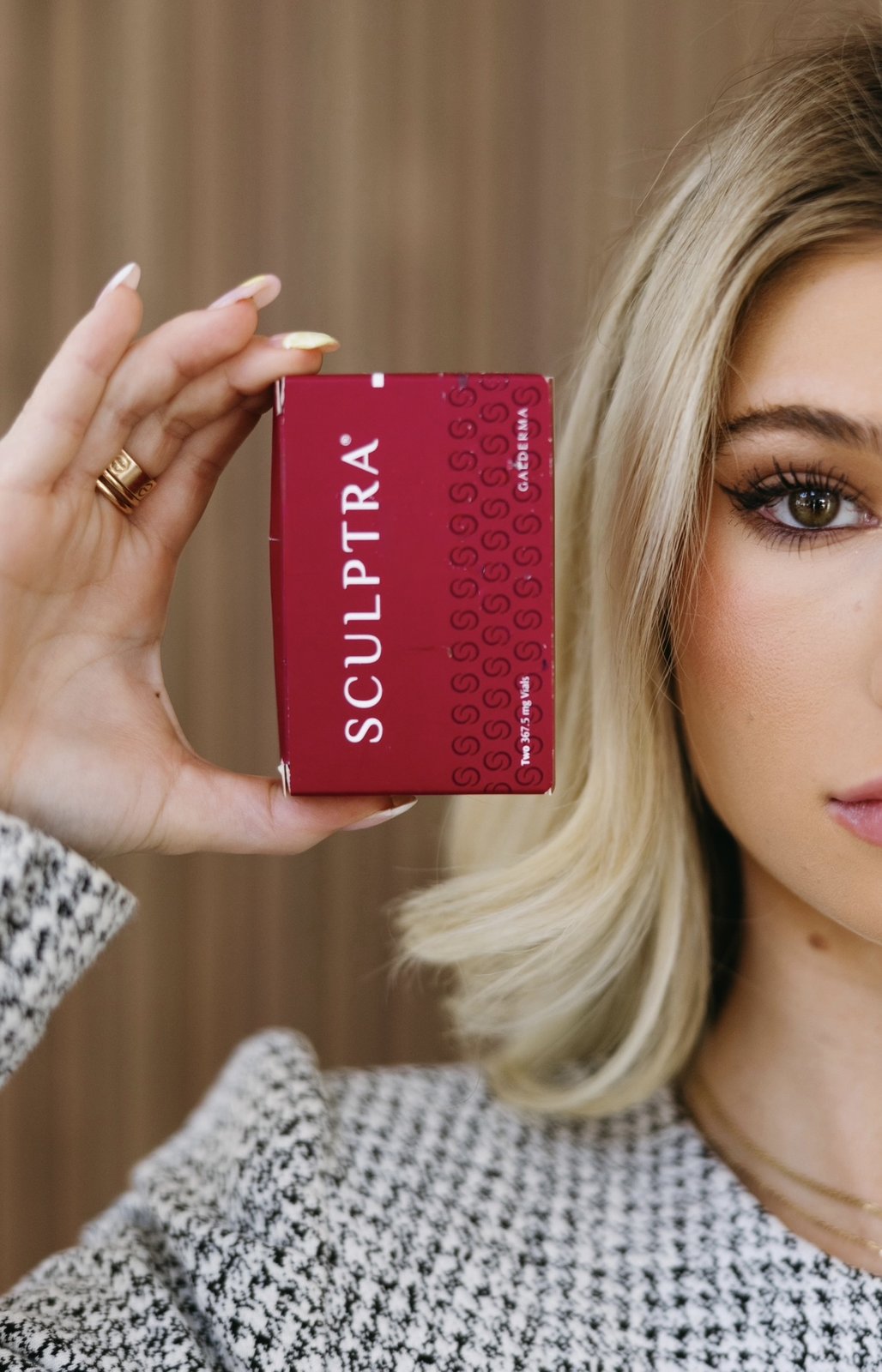
Most injectables add something to your face. Sculptra asks your face to rebuild itself. At Privé Aesthetics in Highland Park, Dallas, it's the treatment we reach for when the goal isn't more volume — it's restored structure, built slowly, from your own collagen.
Part of our complete guide to filler and Sculptra.
There's a moment in a lot of consultations where a patient points to their cheeks or temples and says some version of: "I don't want to look done — I just don't look like myself anymore." What they're usually describing isn't a wrinkle problem or a volume problem. It's a structure problem. The scaffolding underneath the skin — collagen, fat pads, the architecture that gives a face its lift — has thinned. Filler can mask that. Sculptra rebuilds it.
What Sculptra actually is
Sculptra is a poly-L-lactic acid (PLLA) biostimulator made by Galderma — the same family that makes Restylane. The word that matters is biostimulator. It is not a gel that sits under your skin holding up volume. It is a scaffold of microparticles that your body gradually absorbs, and as it does, it triggers your own fibroblasts to lay down fresh collagen around the placement area over the following three to six months.
In other words: the volume you see at month three isn't Sculptra. It's you — your own structure, rebuilt in the places age and gravity thinned it out. That's the whole reason it reads as so natural. There's no foreign material doing the work by month six; there's just more of your own collagen than you had before.
Sculptra vs. filler — the distinction that matters
This is the question we answer most, so here it is plainly. Dermal filler — Juvéderm, Restylane and the rest — is hyaluronic acid gel. It goes in, and it's working that day. It's precise, it's reversible with hyaluronidase, and it's ideal for detail: lips, tear troughs, a specific fold.
Sculptra does almost the opposite job. It works slowly, it isn't reversible, and it isn't for fine detail — it's for restoring broad, structural support across a whole region. The two aren't competitors; they're different tools. The clearest way we put it to patients:
For a lot of patients the right plan uses both: Sculptra to restore the underlying scaffold over a season, then a small amount of filler to refine specific areas once the foundation is back. Asking one to do the other's job is how people end up over-filled — chasing structural loss with syringe after syringe of gel that was never designed to fix it.
Where Sculptra works best
Sculptra is a region treatment, not a pinpoint one. The areas where it shines:
Cheeks and mid-face. The classic indication. As the mid-face deflates, the whole face reads tired and slightly fallen. Sculptra restores diffuse support across the cheek without the bulked, rounded look that aggressive cheek filler can create.
Temples. One of the most under-treated areas in aesthetics and one of the most rewarding. Hollow temples narrow the upper face and age it subtly. A vial or two here can soften that hollowing and rebalance the proportions of the whole face.
Jawline and lower face. Sculptra can rebuild support along the jaw and pre-jowl area, sharpening definition that has softened with time — gradually enough that no one can point to what changed.
What it is not for: lips, and any place that needs precise, sculpted shaping. Those stay filler's job. Sculptra is also used off-label for some body areas — that's a conversation we have privately at consultation, not the focus here.
The timeline — and why patience is the point
If you want to look different by the weekend, Sculptra is the wrong treatment, and we'll tell you so. It is a slow build by design. Here's the honest arc:
The day of treatment, any fullness you see is just the sterile water the product is reconstituted in — it resorbs within a couple of days, and you'll look essentially like you did before. That can be unnerving if you're expecting instant results, which is exactly why we set the expectation up front. Real, collagen-driven change starts to show around six to eight weeks, and the full effect develops over three to six months across a series of two to three sessions.
The trade-off for that patience is longevity. Because you're growing your own collagen rather than placing a temporary gel, Sculptra is one of the longest-lasting non-surgical options available — results commonly hold for two years or more, with many patients topping up a single vial annually to stay ahead of ongoing collagen loss.
Why we dose it conservatively
Sculptra cannot be dissolved. There is no hyaluronidase for a biostimulator — once your body has built collagen, it's there. That single fact drives our entire protocol with it.
We build in a series rather than over-correcting in one visit, because it is always easier to add a vial than to wish we'd used less. We assess how the face is responding between sessions and dose to what's actually happening, not to a prediction. This is the same restraint behind our approach to Botox and filler — with Sculptra the stakes for getting it right the first time are simply higher, so the conservatism matters even more.
Who Sculptra is right for — and who it isn't
It's a strong fit for patients in their late 30s through 60s who are seeing structural change — flattening cheeks, hollowing temples, a softening jaw — and who want a result that builds quietly rather than announcing itself. It's especially good for people who've felt that filler alone left them looking fuller but not more like themselves.
It's not the right fit if you want an immediate, same-day change, or if your concern is fine lines and skin texture rather than deep structure — for that, our regenerative work like SkinPen with Ariessence Pure PDGF is the better pathway. As always, if we think a different treatment serves your goal better, we'll say so.
How Sculptra fits the bigger plan
Sculptra rarely works alone. For most patients it's the foundation layer: Sculptra to rebuild structure over a season, conservative filler to refine specific areas once that foundation is restored, Botox to soften expression lines, and regenerative skin work plus the Luxe Skin Club cadence for surface quality. Structure, refinement, expression, and skin — four different jobs, four different tools, working together. Sculptra is the one that addresses the foundation, which is why we often start there.
Frequently asked
How much does Sculptra cost in Dallas at Privé?
Sculptra is $700 per vial at Privé, with a recommended series of two to three sessions spaced over three to six months. The number of vials depends on how much structural restoration the face needs; we quote the full series at consultation so the total investment is clear before you start.
How is Sculptra different from dermal filler?
Dermal filler (Juvéderm, Restylane) adds instant volume by placing hyaluronic acid gel under the skin. Sculptra adds nothing you can feel on day one — it's a poly-L-lactic acid biostimulator that acts as a scaffold, signaling your body to build its own collagen gradually over three to six months. The result is your own restored structure rather than a gel implant, which is why it reads as exceptionally natural.
When will I see results from Sculptra?
Sculptra is a slow build by design. Any immediate fullness after a session is just the water it's reconstituted in, and it fades within days. Real, collagen-driven change becomes visible around six to eight weeks, and the full effect develops over three to six months as new collagen forms across the treated area.
How long does Sculptra last?
Because Sculptra rebuilds your own collagen rather than placing a temporary gel, the results are among the longest-lasting in non-surgical aesthetics — commonly two years or more. Many patients return for a single maintenance vial annually to keep pace with ongoing collagen loss.
Is Sculptra reversible?
No. Unlike hyaluronic acid filler, Sculptra cannot be dissolved with hyaluronidase — it works by stimulating your own tissue. This is exactly why we dose it conservatively and build in a series rather than over-correcting in one visit: it's far easier to add another vial than to wish we'd used less.
Where on the face does Sculptra work best?
Sculptra is a structural, whole-region treatment — it excels at the cheeks and mid-face, temples, and along the jawline, restoring the broad scaffolding that thins with age. It's not used for lips or for fine, precise shaping; those are filler jobs. Sculptra rebuilds the foundation; filler refines the detail.
Is there downtime with Sculptra?
Downtime is minimal. Expect mild swelling, tenderness, or small bruises for a day or two. We send you home with a simple massage protocol for the treated area over the first several days, which helps the product settle evenly. Most patients return to normal activity the same day.