

The weight comes off, and one morning the face in the mirror looks tired in a way it never did before — flatter, a little hollow, older. This is one of the most common conversations we have with patients on a medically supervised weight-loss program, and it has a straightforward, restoration-first answer.
Part of our complete guide to filler and Sculptra and our guide to medically supervised weight loss.
A GLP-1 program does what it is meant to do: it changes the body. But the body includes the face, and the face loses fat differently — and more visibly — than the rest of us. Patients who are thrilled with their progress on the scale often arrive at our Highland Park studio a little unsettled by what has happened above the neck. Nothing has gone wrong. What they are seeing is a predictable structural change, and it is one Privé is built to address. This piece explains why the face changes during rapid weight loss, when we treat it, and how our regenerative and injectable services rebuild what deflation takes away.
Why rapid weight loss can age the face
The youthful face is not smooth because the skin is thick. It is smooth because it is supported. Beneath the skin sit discrete pockets of fat — the facial fat pads — that give the cheeks, temples, and mid-face their gentle fullness. These pads are the scaffolding. The skin drapes over them the way fabric drapes over a well-built frame.
When you lose weight quickly, you lose fat everywhere, and the facial fat pads deflate along with the rest. The frame shrinks, but the skin that was stretched over it does not shrink at the same rate. The result is what we plainly call weight-loss facial volume loss — the deflated look after rapid loss. The cheeks flatten, the under-eye area hollows, the temples sink slightly, and folds that were softly supported now fall into shadow. Skin that had scaffolding suddenly does not, so it reads as looser and more aged, even though the person is often healthier than they have been in years.
This effect is more pronounced the faster and greater the loss, and more noticeable in patients over 40, whose skin has already begun to lose some of its own collagen and elasticity. It is a structural phenomenon, not a flaw in the weight-loss process. And because it is structural, the fix is structural: you rebuild the support, you do not just resurface the skin.
The timing question
The first thing we usually tell patients is not what to do, but when to do it. As a general rule, we prefer to treat the face once weight is stabilizing, not in the middle of active dose titration on a medically supervised weight-loss program.
The reason is simple. If the face is still actively changing month to month, structural work placed too early may not match where the face finally settles. We would be building volume against a moving target. Restoring the mid-face at a weight you will pass through in two months is not good planning, and it is not respectful of your investment. So for most patients we time the collagen-building and volume work to a stable or near-stable weight, and we plan it during the program so we are ready to move the moment the weight holds.
There are exceptions — some patients benefit from earlier intervention, and skin-quality work can usually begin sooner — but those are individual decisions made at consultation, under physician oversight by Medical Director Dr. Gregory Gardner, DO. If you are already on our compounded tirzepatide program or considering one, the facial-planning conversation folds naturally into your monthly check-ins.
A collagen-first approach
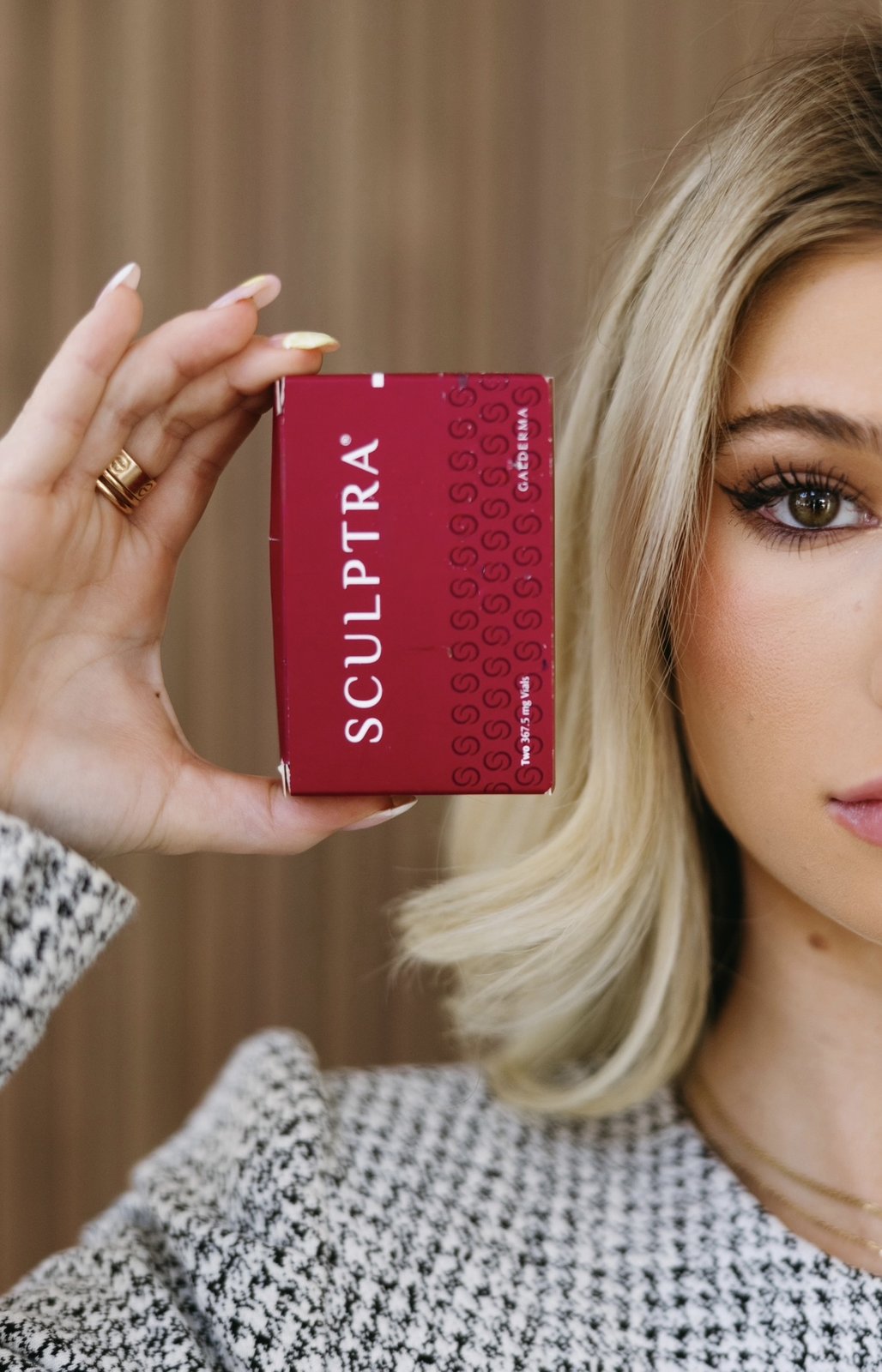
When the loss is broad and diffuse — which post-weight-loss deflation almost always is — the most elegant answer is usually not to inject volume, but to rebuild your own. That is what Sculptra does. Sculptra is a biostimulator: rather than filling a space, it prompts your skin to produce its own new collagen gradually, over a series of sessions, re-establishing the structural support the fat pads used to provide.
This suits the weight-loss face particularly well. The change is global rather than pinpoint, so a treatment that restores overall scaffolding across the mid-face, temples, and cheeks tends to look more natural than chasing each hollow with filler. The results build slowly, which is exactly the point — the face firms and lifts over weeks, so the change reads as looking rested rather than treated. For a fuller explanation of why we reach for a biostimulator first, our piece on Sculptra as collagen, not filler is worth reading alongside this one.
EZGel and regenerative options from your own blood
For the delicate areas — the under-eye, the fine transitions of the mid-face — we often turn to EZGel, a regenerative treatment prepared from a small draw of your own blood. Processed into a natural gel, it can be used to restore soft volume and improve skin quality in regions where traditional filler can look heavy or unnatural.
Because it comes from your own body, EZGel is a favored option for patients who want restoration in the tear-trough and mid-face without the risk of an over-filled look. It works with your tissue rather than sitting on top of it, and it pairs well with a collagen-first plan: Sculptra rebuilds the broad structure, EZGel refines the areas that need a softer, more biological touch.
Targeted dermal filler for specific volume
There are places where immediate, precise volume is the right tool, and for those we use targeted dermal filler. Where Sculptra rebuilds diffuse structure over time and EZGel refines the delicate zones, filler restores defined volume in a specific area right away — a flattened cheek apex, a deepened fold, a specific point of support that the deflation exposed.
In the post-weight-loss plan, filler is usually a finishing instrument, not the foundation. We place it sparingly and only where it earns its place, because the face that has just lost its natural fullness is unforgiving of anything that looks added. Used with restraint, filler completes the restoration; used heavily, it announces itself. We stay firmly on the side of restraint.
Skin quality — texture and laxity
Rebuilding structure is half the picture. The other half is the skin itself, which after rapid loss can read as looser and more textured. Here we work at the surface. SkinPen microneedling paired with Ariessence Pure PDGF is our signature regenerative protocol for skin quality: SkinPen creates precise micro-channels that trigger the skin's repair response, and Ariessence Pure PDGF — a topical growth-factor formulation applied to the skin after the microneedling pass — supports that renewal. Applied topically, it is part of how we improve tone and texture; it is never used as an injection.
For laxity and deeper textural change, radiofrequency (RF) microneedling adds controlled thermal energy beneath the surface to tighten and remodel over a series of treatments. Together, these skin-quality treatments address the looseness and crepiness that structural work alone will not, and because they are gentler on timing, they can often begin earlier in the weight-loss journey than the volume work.
Building the plan at consultation
No two weight-loss faces deflate the same way, so there is no template protocol. What there is, is a method: at consultation we assess where you have lost structural support, where the skin needs help, and where you are in your weight trajectory. From there we sequence the work — skin quality first where appropriate, collagen-building as weight stabilizes, EZGel and targeted filler to refine, all paced to your program and your goals.
For patients already on our medically supervised weight-loss program under Dr. Gardner's oversight, this is a natural extension of care you are already receiving: the same measured philosophy, applied above the neck. The weight-loss work changes the body; the facial-restoration work makes sure the face keeps up. Results vary by individual, and every plan is built one consultation at a time.
Frequently asked
Does weight loss age your face?
Rapid weight loss can change the face because the facial fat pads that give the mid-face its youthful fullness deflate along with fat elsewhere in the body. When those pads shrink, the skin that was resting on them loses its underlying support and can look flatter, more hollow, and less lifted. This is a normal structural effect, not a sign that anything is wrong. Results vary by individual, and how noticeable the change is depends on age, skin quality, and how much and how quickly weight was lost. At Privé we address it by rebuilding structure rather than simply adding volume.
Should I wait until I'm done losing weight to treat my face?
In most cases we recommend treating the face once weight is stabilizing rather than in the middle of active dose titration on a GLP-1 program. If the face is still actively changing, structural work placed too early may not match the final result. There are exceptions we discuss individually, but as a general rule we time collagen-building and volume work to a stable or near-stable weight so the plan holds. This is decided at consultation under physician oversight by Medical Director Dr. Gregory Gardner, DO.
Is Sculptra or filler better after weight loss?
They do different jobs and are often used together. Sculptra is a collagen biostimulator that rebuilds the face's own structural support gradually over a series of sessions, which suits the broad, diffuse volume loss common after significant weight loss. Targeted dermal filler restores volume in a specific area immediately. Many post-weight-loss plans use Sculptra to re-establish overall scaffolding and reserve filler for defined areas that need precise correction. The right balance is determined at consultation. Results vary by individual.
Will treating my face after weight loss look overdone?
Not with our approach. Privé's philosophy is conservative and restoration-first: the goal is to return the face to looking like itself, rested and supported, not to inflate or reshape it. We build gradually, favor biostimulators that work with your own collagen, and place filler sparingly and only where it is needed. It is easier to add more later than to correct too much, so we start measured and reassess.
When should I start thinking about facial treatment during weight loss?
The best time to start the conversation is early, even if the treatment itself comes later. Coming in for a consultation while you are on the program lets us document your baseline, watch how your face is changing, and plan the timing of collagen and volume work around when your weight stabilizes. Skin-quality work such as SkinPen microneedling and RF microneedling can often begin sooner. Every plan is individual and is built under physician oversight.