Skin rejuvenation is a category, not a treatment — it covers about eight procedures working at eight different depths. This guide lays out the whole ladder from dermaplaning to fractional resurfacing, what each one actually treats, how we choose between them, why the season decides half of it, what it costs, and what none of it will do.
The ladder, gentlest to deepest
“Skin rejuvenation” is a category, not a procedure. Every clinic in Dallas sells it and almost none of them tell you what it means, because the honest answer is that it covers about eight different treatments working at eight different depths.
Here is the whole ladder, in order. Everything below is just detail on the rungs.
- Dermaplane & facials — surface only. No downtime.
- Chemical peels — controlled removal of a depth of skin.
- IPL photofacial — light targeting pigment and vessels, not texture.
- Clear + Brilliant — gentle fractional laser, minimal downtime.
- Microneedling — collagen induction by controlled micro-injury.
- RF microneedling — the same, plus heat delivered at depth.
- Fractional resurfacing — the deepest, with real downtime.
Nobody needs all seven. Most people need two, in sequence, timed to the season.
Facials & dermaplane
The bottom rung and the one that does the most unglamorous work. Dermaplaning removes vellus hair and the dead surface layer with a surgical blade. DiamondGlow exfoliates, extracts and infuses serum in one pass. Our Fresh Face Facial runs a double cleanse, massage, dermaplane, enzyme exfoliation, an antioxidant mask and finishing serums.
No downtime, and the right answer two days before an event when a peel or a laser is emphatically the wrong one. Every four to six weeks suits most people. More on the glow facials here.
Chemical peels
A peel uses acid to remove a controlled depth of skin so the tissue underneath repairs. Depth is the entire variable: superficial peels brighten and smooth with a few days of flaking; medium-depth reaches pigment and texture and asks for a quiet week.
We run a Jessner blend for tone correction and TCA where deeper resurfacing is wanted, chosen for your skin rather than picked off a menu. Peels want low UV and a few quiet days, which is why they live in the cool months. The full piece on peels, and why we wait for peel season.
IPL photofacial
Intense pulsed light targets colour — brown pigment and the haemoglobin in visible vessels. It is the right tool for sun spots, freckling, rosacea redness and broken capillaries, and the wrong tool for texture, which it does almost nothing for.
It is a series, typically three sessions a few weeks apart. Spots darken for a day or two and lift away. Skin type genuinely restricts this one — at Fitzpatrick IV and above we spot-treat only, never full-field, and recent sun is a reschedule rather than a negotiation. More on IPL, and how it compares to peels and resurfacing for brown spots.
Clear + Brilliant
A gentle non-ablative fractional laser — it creates microscopic treatment zones in the skin without removing the surface. Tone, texture, pores and early sun damage, with roughly a day of flush and a few days of fine sandpaper feel.
It is the treatment for someone who wants real change and cannot be out of circulation, and it is safe across a wider range of skin types than IPL. Series of three, maintained once or twice a year. The full piece.
Microneedling & RF microneedling
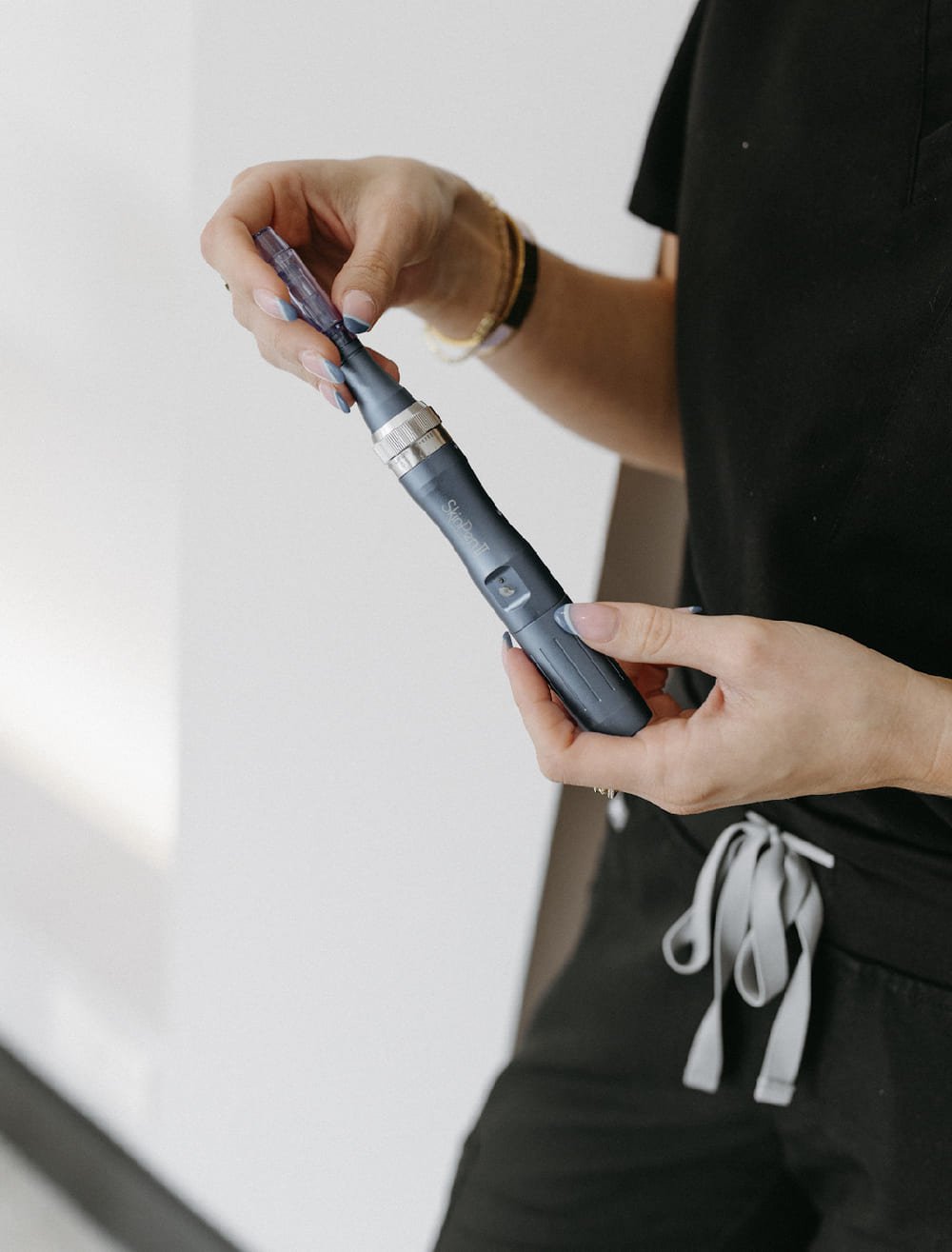
SkinPen microneedling creates controlled micro-injuries that trigger collagen induction. It is the workhorse for texture, fine lines and scarring, and it is where our signature protocol lives — topical Ariessence Pure PDGF applied into the channels immediately afterward, covered in the regenerative guide.
RF microneedling adds radiofrequency heat delivered at depth through the needles, which reaches tightening and scar remodelling that needling alone does not. More downtime, more result. When we choose it over SkinPen, and how all three compare.
Fractional resurfacing
The top of the ladder. Fractional ablative resurfacing removes columns of tissue across a fraction of the surface, leaving untreated skin between them to drive healing. It reaches deep wrinkles, significant sun damage, and textural scarring that lighter modalities cannot.
It asks for real downtime — days, not hours — and that is the trade for a single-session result. It belongs in the cool months and it belongs in a week you have cleared. On scarring specifically, and the Laser360 combination protocol for layering modalities in one plan.
How we actually choose
Three questions, in this order.
- Is the problem colour or texture? Colour — pigment, redness, vessels — points to light. Texture, pores, scarring and laxity point to collagen. Treating one with the other is the most common wasted series.
- How much downtime can you genuinely take? Not aspirationally. The honest number narrows the ladder faster than anything else.
- What season is it? See below. It is not a detail.
And one we ask ourselves: is the barrier healthy enough to treat at all? If not, nothing on this page happens yet.
Why season decides half of this
Light and ablative treatments want skin that is not holding sun, and treated skin is more vulnerable to UV afterwards. Treating pigment in a Dallas July and then sending you back outside undoes the work and can drive it back worse.
So the corrective half of the ladder — peels, IPL, resurfacing, pigment work — lives from October to February. The maintenance half — facials, dermaplane, DiamondGlow — runs year-round. Why fall is laser season, and what a Dallas summer actually does to skin.
What it costs
- Dermaplane — $75
- DiamondGlow facial — $200 ($150 Friday special)
- Fresh Face Facial — $225
- Fire & Ice Facial — $225
- Jessner chemical peel — $200
- IPL photofacial — from $175
- SkinPen microneedling — from $225 (PDGF upgrade $300)
- Clear + Brilliant — $550, or $1,500 for three
- RF microneedling — from $700
- Fractional resurfacing — from $500
All published, none quoted on request. Full price list. The Luxe Skin Club includes one signature treatment monthly plus 20% off lasers and packages year-round.
What none of it will do
None of these lift significantly loose skin. That is a surgical conversation, and a clinic that sells you a laser series for it is taking your money. None of them replace lost volume — that is filler or a biostimulator. And none of them is permanent: skin keeps ageing and keeps seeing sun, so every result here is maintained rather than finished.
They also do not work without the unglamorous part. Daily sunscreen and a retinoid do more over a decade than any single series, and they are what makes the series hold. On restarting retinol properly.
Frequently asked
What is skin rejuvenation, actually?
It is a category, not a treatment. It covers everything that improves the surface and quality of skin — facials, dermaplaning, chemical peels, IPL, fractional lasers and microneedling. Anyone selling you 'skin rejuvenation' as a single named procedure is selling you a package. The useful question is which rung of the ladder your skin needs.
How much does skin rejuvenation cost in Dallas?
At Privé: dermaplane $75, DiamondGlow facial $200 ($150 on the Friday special), Fresh Face Facial $225, Fire & Ice Facial $225, Jessner chemical peel $200, IPL photofacial from $175, SkinPen microneedling from $225, Clear + Brilliant $550 or $1,500 for a package of three, RF microneedling from $700, and fractional resurfacing from $500. Full pricing is published at privemedical.com/pricing.
What is the difference between a facial and a chemical peel?
A facial works on the surface — cleansing, exfoliation, extraction, hydration — and has no downtime. A peel uses acid to remove a controlled depth of skin so the layer underneath is revealed and the tissue repairs. A facial makes skin look better that week; a peel changes what the skin is over the following month.
Which treatment is best for brown spots?
Usually IPL, which targets pigment with light and clears it over a series. Peels help with superficial pigment and tone. Melasma is the exception and needs a far more conservative, layered approach, because aggressive light treatment can make it worse rather than better. Getting that distinction right at consultation matters more than the device.
Which treatment is best for texture and pores?
Collagen-building treatments: microneedling, RF microneedling, or fractional resurfacing, depending on how much downtime you can take and how deep the change needs to go. Clear + Brilliant refines surface texture with very little downtime and is the usual starting point for someone who cannot be out of circulation.
Which treatment is best for acne scars?
Textural scarring needs collagen remodelling at depth — RF microneedling or fractional resurfacing across a series, in the cool months. Most of what people call acne scarring is actually post-inflammatory pigment, which fades on its own and responds to gentler treatment. We will tell you which you have; they look alike and they are not.
How often should I have a treatment?
Surface work every four to six weeks, which tracks your skin's own turnover. Collagen series run three to six sessions spaced four to six weeks apart, then maintenance once or twice a year. More often is not more benefit — it is just more exfoliation than skin asked for.
Is there downtime?
It scales with depth. Facials and dermaplaning: none. IPL: a day or two of darkened spots lifting to the surface. Clear + Brilliant: a day of flush and a few days of sandpaper texture. Microneedling: two to three days of redness. Fractional resurfacing: genuine downtime measured in days, which is the trade for the result.
Can I have these treatments on darker skin?
Microneedling, RF microneedling, peels at appropriate depth and Clear + Brilliant are all used across skin types. Light-based treatment is where skin type genuinely restricts what is safe — IPL is spot-treatment only at Fitzpatrick IV and above here, never full-field. Any provider who does not raise this before treating you with light is a provider to leave.
Why do you push everything to autumn and winter?
Because light and ablative treatments want skin that is not holding sun, and because treated skin is more vulnerable to UV afterwards. Treating pigment in July in Dallas and then sending you into the sun undoes the work. October through February is when the corrective treatments are both safest and most effective.
Who performs these at Privé?
Laser and skin treatments are performed by our licensed medical aesthetician and laser technician, with medical oversight by Medical Director Dr. Gregory Gardner, DO. Injectables are performed by Elizabeth Hurley, RN, BSN, CANS.
What should I do between treatments?
Sunscreen every morning, a retinoid at night once your barrier tolerates it, and a barrier moisturiser. That routine does more for your skin over ten years than anything on this page, and it is what makes professional treatment hold between visits.
When the answer is to do nothing
If your barrier is compromised — tight after cleansing, stinging at products that never used to sting, flaking that moisturiser fixes for an hour — the correct treatment is two weeks of leaving it alone. If you had something done a fortnight ago, the answer is wait. If you are booking out of anxiety rather than a plan, the answer is a consultation and not a treatment.
We would rather reschedule you than treat skin that is not ready. Treating irritated skin produces a worse result and a longer recovery, and you paid for neither.